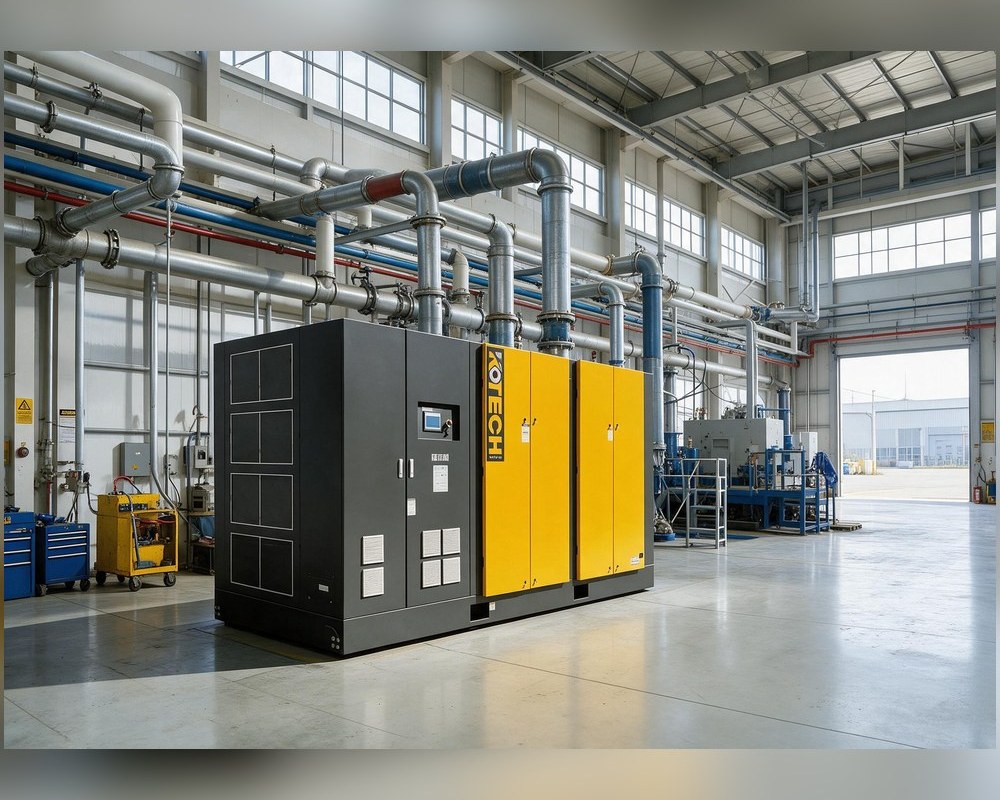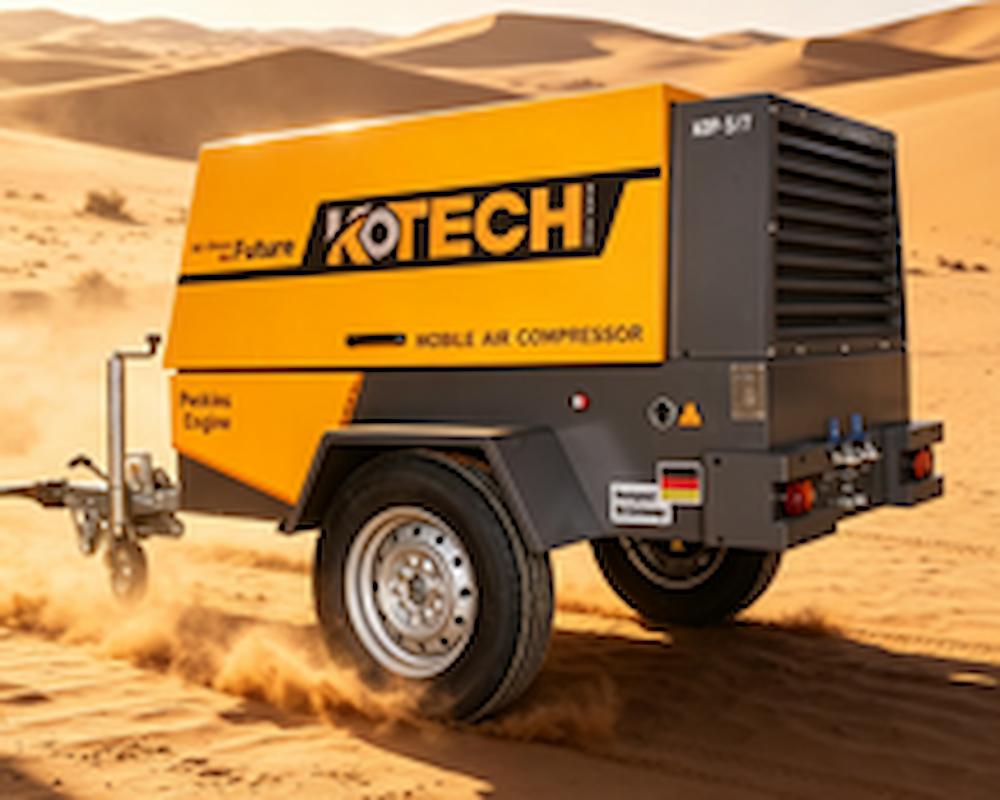




Diesel Powered Air Compressor: Complete Guide for Jobsite Projects (Sizing, Specs, Climate & Buying Checklist)
A diesel powered air compressor is the go-to solution for outdoor and remote jobsites where stable electricity is limited, but fuel is accessible and uptime matters. In real-world project work—sandblasting, drilling rigs, rock breaking (jackhammers), and pipeline construction—diesel-driven units are often the most practical because they are mobile, self-contained, and built for continuous operation.
If you’re selecting a diesel engine air compressor for hot climates (common across the Middle East) or high-altitude sites, this guide will help you avoid the most common sizing mistakes and choose a configuration that stays stable under real conditions.
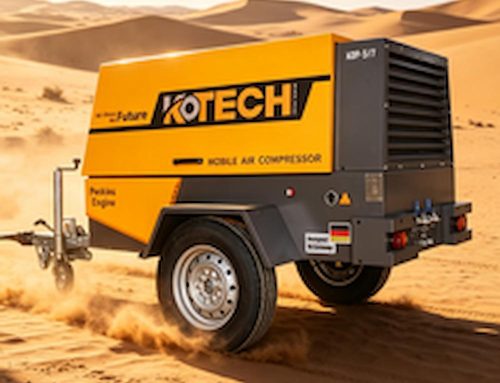
Kotech KDP Series (recommended models & configurations):
KDP Series Portable Diesel Air Compressor
What is a diesel powered air compressor?
A diesel powered compressor is a portable air compressor driven by a diesel engine instead of an electric motor. It is commonly chosen for:
- Outdoor job sites that move frequently (construction, pipeline projects)
- Remote or off-grid locations (limited electrical infrastructure)
- Harsh environments (heat, dust, long-hour operation)
In practice, buyers often use “diesel powered air compressor,” “diesel air compressor,” and “diesel engine air compressor” interchangeably. The selection logic remains the same: start from application requirements (pressure + airflow + duty cycle), then adjust for site conditions.
Start here for model range & configuration recommendations:
KDP Pace Series Large Diesel Mobile Air Compressor
Quick specs & practical ranges (KDP Series)
For project buyers, the fastest way to shortlist a diesel engine air compressor is to confirm whether the product line covers your needed pressure/airflow range and can be configured for your environment.
| Item | Range |
|---|---|
| Working pressure | 7–35 bar |
| Airflow (CFM range) | 185–1600 CFM |
| Air delivery | 1–35 m³/min |
| Power rate | 8.2–602 kW |
Conversion tip (for RFQs from different regions):
Convert bar to PSI |
MPa to PSI Converter
How does a diesel engine air compressor work?
A typical diesel powered air compressor includes these major modules:
- Diesel engine: provides mechanical power
- Airend (compression element): compresses air (commonly screw technology in portable units)
- Cooling system: manages discharge temperature (critical for hot climates)
- Filtration / separation: manages oil and particulate (design dependent)
- Controller & protections: regulates output and protects the system (over-temp, over-pressure, alarms)
In real jobsite work, output stability depends not just on the “headline spec,” but also on cooling margin, filtration effectiveness, and serviceability (how easily you can keep the unit clean in dust-heavy environments).
For project-oriented selection:
View KDP Series configurations
Key specs explained: what matters on-site (and common mistakes)
This section is designed to prevent the most common purchasing errors—especially in sandblasting and drilling projects where real output stability is more important than theoretical peak numbers.
| Spec | What it means | Why it matters on-site | Common mistake |
|---|---|---|---|
| Airflow (CFM / m³/min) | How much air the unit delivers | Drives blasting speed, drilling efficiency, multi-tool stability | Choosing too low → pressure drops and slow output |
| Pressure (bar / PSI) | Maximum working pressure | Must match tools/process requirements | Buying high pressure when airflow is the real bottleneck |
| Duty cycle | Continuous operating capability | Outdoor projects often run long shifts | Underestimating daily runtime and maintenance load |
| Ambient temperature & dust | Site environment conditions | Heat reduces cooling margin; dust increases service frequency | Ignoring Middle East summer heat and dust load |
| Altitude | Height above sea level | Can derate engine power & compressor output | Selecting based on sea-level brochure values |
| Air quality & moisture | Aftercooler, filtration, drains | Impacts blasting quality, tool life, pipeline drying results | Not planning for water/oil/particulate control |
Performance terminology note: If you’re comparing different vendors, it helps to understand SCFM vs CFM and the standard conditions behind published numbers. See:
SCFM vs CFM (What is SCFM in air compressors?)
Sizing by application (practical project logic)
To size a diesel powered air compressor correctly, you must start from the application and tools—not from the compressor brochure alone. Below is a practical framework that works well for project RFQs.
Sandblasting (airflow stability is usually the bottleneck)
In sandblasting, stable airflow delivery typically drives productivity. Buyers should prepare:
- Nozzle type & nozzle size (or blasting pot setup)
- Target blasting pressure
- Continuous working hours per day
- Site conditions: heat + dust level
Internal reading:
Sandblasting application |
Sandblasting air compressors (industry notes)
Recommended next step: For model matching under real jobsite conditions, reference:
KDP Series diesel powered air compressor configurations
Drilling rigs & borehole drilling (pressure + airflow matching)
Drilling applications often require both pressure and airflow alignment with the rig/hammer requirements. Prepare:
- Rig model / hammer requirement (if available)
- Target working pressure range
- Airflow requirement under continuous cycles
- Altitude range (derating matters)
Internal reading:
Drilling air compressors |
Air compressors in borehole drilling
Project selection page:
KDP Series (7–35 bar; up to 1600 CFM)
Rock breaking / jackhammers (multi-tool stability)
Rock breaking often expands from a single tool to multiple tools, increasing total airflow demand. Common on-site mistake: selecting “just enough” for one tool and then facing pressure drops later.
Internal proof (case):
Diesel air compressor for jack hammer (case)
Convert and confirm pressure units if needed:
Convert bar to PSI
5.4 Pipeline construction & pipeline cleaning/drying
Pipeline projects can involve general pneumatic tools (construction support) and also pipeline cleaning/drying where moisture and oil content may become critical factors.
Internal reading:
Pipeline cleaning and drying
Important note: If oil-free air is required for your pipeline process, consider oil-free solutions (see the oil-free section below).
Hot climate, dust & high altitude: what changes on real jobsites
In regions with extreme heat (common in Middle East job sites), cooling systems work harder, and dust increases the frequency of radiator and filter cleaning. At high altitude, reduced air density can derate output and stability.
Hot climates (heat load & cooling margin)
- Heat reduces cooling efficiency and increases discharge temperature risk
- Cooling system service access becomes a “buying spec” (not a maintenance detail)
- Stable output matters more than headline peak numbers
Dust (filtration reality)
- Dust-heavy sites demand a practical filtration plan and easy cleaning access
- Neglecting filtration can reduce tool life and increase downtime
High altitude (derating)
- Altitude can reduce available engine power and output stability
- Size with margin and include altitude range in your RFQ
Internal reference (site condition explanation):
What is ambient pressure and why it is important?
Air quality & moisture control: when it matters (ISO classes, pipeline drying)
Not all applications require the same air purity. For general construction tools, basic filtration may be sufficient. For certain pipeline processes, drying/cleaning, or sensitive operations, moisture and oil control can become much more important.
Internal guidance:
Pipeline cleaning & drying (oil-free considerations)
Filter fundamentals (internal guide):
Top 3 important air compressor filters guide
Industry note: ISO 8573-1 is commonly used to classify compressed air purity (particles, water, oil). (See references section.)
Compressor types: towable vs skid vs containerized; oil-injected vs oil-free
Towable vs skid-mounted
- Towable: fast relocation and flexible deployment for contractors
- Skid-mounted: better for mounting on trucks or staged site setups
Containerized compressed air systems (project-style)
For large or staged projects (EPC, mining, oil & gas temporary installations), containerized systems can simplify installation and onsite management.
Internal reading:
What is containerized compressed air system and how it works?
Oil-injected vs oil-free: when oil-free is required
Many portable jobsite compressors are oil-injected screw designs. If your process requires oil-free air (often raised in pipeline drying/cleaning scenarios), you should evaluate oil-free options separately.
Oil-free diesel portable option (internal):
KOP Series (100% oil free diesel portable air compressor)
Maintenance plan for uptime (field habits)
A project buyer should treat maintenance as part of the selection—not as an afterthought. In hot and dusty sites, a simple, realistic schedule prevents most downtime.
Internal guide (recommended to include in RFQ preparation):
Diesel portable air compressor maintenance guide
For seasonal environments, this also helps:
Air compressor maintenance guide for cold weather
Buying checklist & RFQ template (project-based)
To get a correct recommendation for a diesel powered air compressor (and avoid back-and-forth), prepare the following:
- Application: sandblasting / drilling / rock breaking / pipeline
- Required pressure: bar or PSI (include range if possible)
- Target airflow: CFM / m³/min (or tool list + quantity)
- Duty cycle: hours/day, continuous vs intermittent
- Site conditions: temperature range + dust level
- Altitude: approximate altitude range
- Mobility preference: towable / skid / staged installation
- Destination country: service expectations, configuration planning, export packing
RFQ template (copy & paste):
We need a diesel powered air compressor for [sandblasting/drilling/jackhammer/pipeline].
Working pressure: [__ bar / __ PSI]. Target airflow: [__ CFM / __ m³/min] or tools list: [__].
Site conditions: Temperature [__°C], dust level [low/medium/high], altitude [__ m].
Working hours: [__ hours/day]. Mobility: [towable/skid]. Destination: [country].
Please recommend a KDP Series configuration and provide a practical quotation (lead time + packing plan).
Model selection page:
KDP Series Portable Diesel Air Compressor
FAQ: diesel powered air compressor
What is a diesel powered air compressor used for?
KDP Series.
Is “diesel engine air compressor” the same thing?
What matters more: CFM or pressure?
SCFM vs CFM.
How do hot climates affect diesel portable compressors?
Does high altitude reduce output?
When do I need an oil-free diesel portable air compressor?
KOP Series.
Need a fast recommendation? Send your application + pressure + airflow (or tool list) + temperature/altitude, and we’ll suggest a suitable configuration.
Get KDP Series recommendation
Reference Sources
External sources are provided for terminology and standards context.
- ISO 1217: Displacement compressors — Acceptance tests
- CAGI: Performance verification (ISO 1217 simplified test codes)
- ISO 8573-1: Compressed air purity classes (particles, water, oil)
- OSHA 1917.154: Compressed air safety for cleaning
Related Posts (Internal Links)
- KDP Series Portable Diesel Air Compressor
- Best Portable Air Compressors (Comparison Guide)
- Diesel Portable Air Compressor Maintenance Guide
- Sandblasting application
- Drilling air compressors
- Pipeline cleaning and drying
- Diesel Engine Air Compressor: How It Works, Key Specs & Buying Checklist
Final
If you’re selecting a diesel powered air compressor for outdoor projects in hot climates or high-altitude regions, don’t size by brochure numbers alone. Share your application, pressure, airflow (or tool list), duty cycle, temperature, dust level, and altitude. We’ll recommend a stable configuration and provide a practical quote.