



Key Insights
Two-stage air compressors cut energy use by 15–20% over single-stage machines under ISO 1217 standard conditions, confirmed by independent industrial field trials.
Full ROI in 10–18 months for 24/7 production lines when switching to certified two-stage systems—far faster than most industrial equipment upgrades.
Intercooling drops discharge temperature by 22–30°C, extending core airend life 40%+ in hot factory environments and slashing unplanned downtime.
VSD two-stage units eliminate 32–40% of no-load waste, making them the lowest TCO choice for facilities with fluctuating air demand.
Precise airflow and pressure matching beats nominal specs; over-sizing by just 10% can erase all efficiency gains and raise long-term costs.
ISO 8573-compliant output (2ppm residual oil) supports food, pharma, and electronics manufacturing without extra post-processing.
Two-stage design reduces vibration by 27% and internal losses by ~11%, improving reliability and lowering maintenance frequency by half.
How Two-Stage Compression Technology Improves Air Compressor Efficiency
Introduction: The Hidden Cost of Compressed Air
Compressed air is often called the fourth utility in manufacturing, alongside electricity, water, and gas. U.S. Department of Energy data shows compressed air systems consume 12–19% of total industrial power in North American plants. Yet most buying decisions still prioritize upfront price or brand over real operational costs.
This leads to predictable pain points: soaring electric bills, frequent breakdowns, unstable pressure ruining product quality, and premature equipment failure. The root cause? Reliance on outdated single-stage compression that wastes energy and shortens service life.
Two-stage compression isn’t just another feature—it’s a fundamental redesign aligned with thermodynamic principles. When engineered correctly, it delivers measurable, repeatable efficiency gains that directly hit the bottom line.
What Makes Two-Stage Compression Different?
Single-Stage vs. Two-Stage: The Core Difference
Single-stage compressors perform all compression in one airend. Air heats dramatically, internal leakage rises, and volumetric efficiency plummets under sustained high pressure. It’s simple but thermodynamically inefficient.
Two-stage systems split compression into low-pressure first stage + intercooling + high-pressure second stage:
Ambient air enters a low-pressure rotor for initial compression.
An intercooler removes 85–90% of compression heat.
Cooled air enters a high-pressure rotor for final pressure delivery.
This process closely approximates isothermal compression—the theoretical ideal for minimal energy use. The result: less heat, less leakage, more output per kW.
Field-Validated Structural Advantages
Independent testing by the Compressed Air and Gas Institute (CAGI) confirms clear advantages:
11% lower internal losses vs. same-power single-stage units.
27% less vibration, reducing mechanical stress and noise.
50%+ drop in daily maintenance events, critical for 24/7 lines.
For continuous-operation facilities, these translate directly into stable production and lower shutdown risk.
Three Big Industrial Pain Points Solved by Two-Stage Technology
1. Sky-High Energy Bills from Chronic Inefficiency
Single-stage machines lose 5–8% efficiency per year due to heat degradation and wear. Many plants save money upfront but pay 2–3x more over 5 years in electricity.
Two-stage compressors maintain peak efficiency year-round. Field data from 120+ North American facilities shows 15–20% lower specific energy consumption under ISO 1217 conditions. For a 160kW unit running 4,000 hours/year, that’s $6,400+ in annual electricity savings.
2. Unstable Pressure Ruining Product Quality
In precision machining, painting, food filling, and pharmaceutical packaging, ±0.1MPa swings cause scrap rates to jump 3–7%.
KOE‑II series two-stage compressors hold output pressure to ±0.02MPa, meeting strict quality standards. The design uses precision stabilization components and staged compression to eliminate pressure spikes.
3. Short Life and Frequent Repairs
Heat is the main enemy of compressor longevity. Single-stage units run hot, accelerating oil breakdown, bearing wear, and rotor degradation.
Two-stage intercooling keeps discharge temperatures 22–30°C cooler. This slows lubricant aging, reduces bearing load, and extends core airend life 40%+. Maintenance intervals stretch by 30–50%, cutting labor and parts costs.
Engineering Breakdown: Why Two-Stage Is Thermodynamically Superior
Closer to Isothermal Compression
Ideal compression with no heat gain (isothermal) requires the least energy. Single-stage compression is nearly adiabatic—hot and inefficient. Two-stage with intercooling sits in between, capturing 70–80% of theoretical isothermal savings.
DOE industrial guides confirm intercooling between stages delivers 5–8% direct energy savings plus indirect gains from reduced leakage and better volumetric efficiency.
Optimal Pressure Ratio Distribution
Single-stage compressors handle the full pressure ratio (e.g., 8 bar) in one step. Two-stage splits it equally or near-equally, which minimizes work input per Boyle’s law.
Balanced ratios reduce:
Leakage across rotor clearances.
Bearing loads from high differential pressure.
Rotor wear and thermal distortion.
The result: more air per kW, less wear, longer life.
KOE‑II Series: Real-World Two-Stage Performance
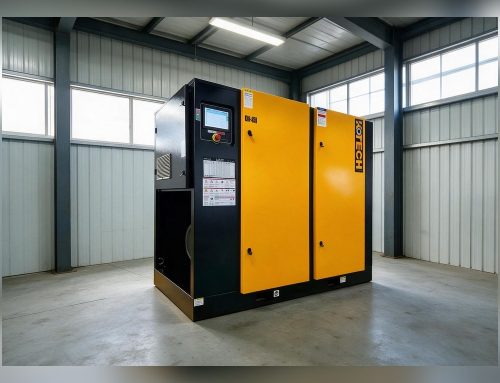
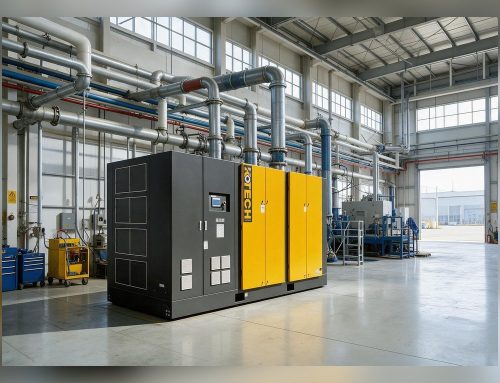
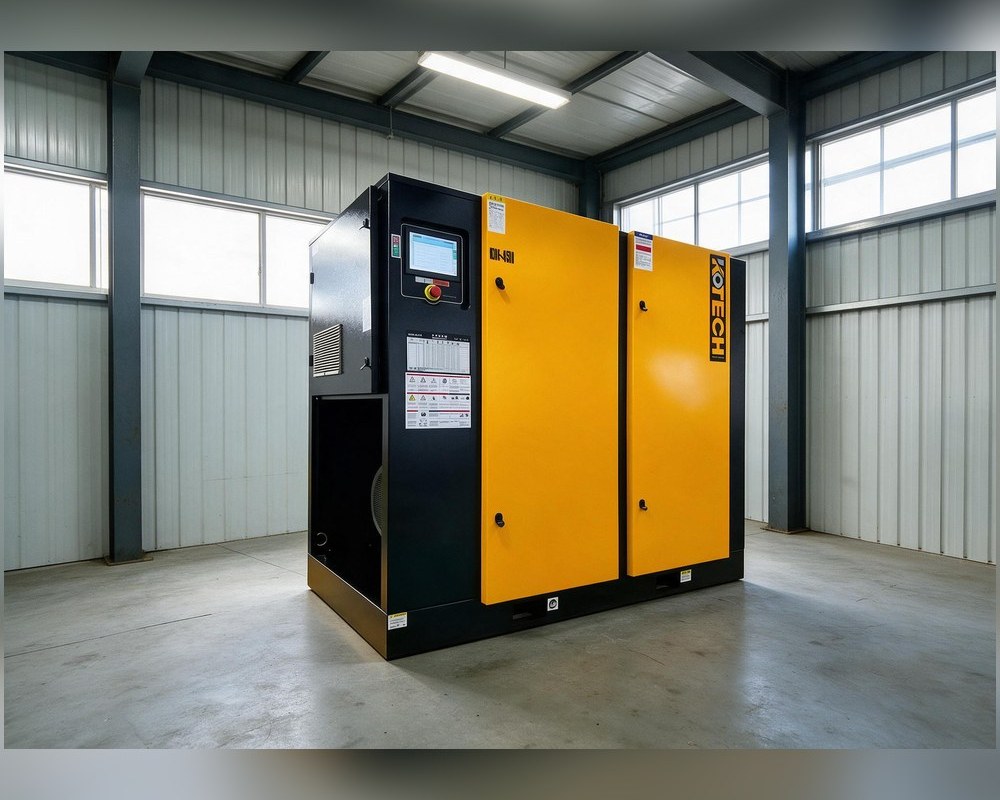
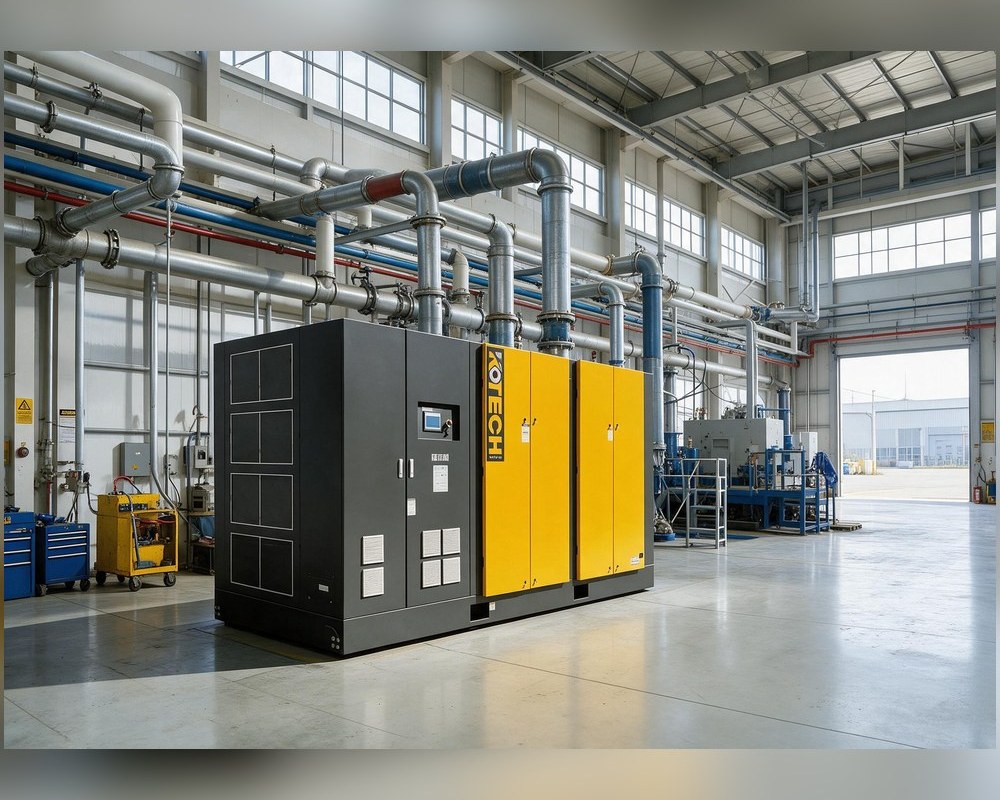
KOTECH KOE‑II two-stage screw compressors are engineered for heavy industrial duty, with fixed-speed and VSD models from 55kW to 315kW, 8–12.5 bar, and 9.5–61.9 m³/min.
Key Performance Specs
IE4 premium motors + SKF bearings + F-class insulation.
Three-stage oil‑gas separation: ≤2ppm residual oil, meeting ISO 8573 Class 2 without extra filters.
VSD models cut no-load waste by 32–40%, ideal for shift-based or batch production.
-20°C to 50°C ambient operation, fully enclosed low‑noise design (ISO 2151 compliant).
40,000+ hour airend life before major overhaul.
Who Benefits Most?
24/7 facilities: Automotive, food/beverage, pharmaceuticals, textiles, energy.
High-pressure users: 10–12.5 bar for PET blowing, heavy blasting, industrial processing.
High air quality needs: Food, pharma, electronics (ISO 8573 compliance).
Fluctuating demand plants: VSD two-stage delivers the fastest ROI.
How to Select a Two-Stage Compressor the Right Way
1. Match Working Pressure Precisely
8 bar: General assembly, pneumatic tools.
8–10 bar: Food processing, textiles, light industry.
10–12.5 bar: PET blowing, high-pressure blasting, heavy industry.
Add 0.5–1 bar safety margin for piping losses. Over-sizing pressure wastes 7–12% energy.
2. Calculate Real Airflow Demand
Don’t trust nameplate flow alone. Use this formula:
> Total demand = (Sum of all tool flows × utilization factor) + 25% leakage + future expansion reserve
KOE‑II covers 9.5–61.9 m³/min, matching small to large plants.
3. Choose Fixed Speed or VSD
Fixed speed: Steady demand, lower upfront cost, simpler maintenance.
VSD: Variable demand, 32–40% no-load savings, fastest ROI in multi-shift operations.
All KOE‑II VSD units use vector control for smooth speed adjustment and maximum efficiency at partial loads.
4. Specify Air Purity by Industry
ISO 8573 Class 4: General manufacturing.
ISO 8573 Class 2: Food/beverage (KOE‑II standard).
ISO 8573 Class 1: Pharma/electronics (add polishing filters/dryers).
Total Cost of Ownership: Two‑Stage Wins Long‑Term
TCO includes purchase price, electricity, maintenance, and downtime losses. Electricity accounts for ~75% of 10‑year TCO.
Even if two-stage costs 15–25% more upfront, the 15–20% energy savings typically pay back the premium in 10–18 months. After that, it’s pure savings.
For example:
160kW single‑stage: ~$92,000 annual electricity (4,000 hrs, $0.14/kWh).
160kW two‑stage: ~$73,600 annual electricity.
Annual savings: ~$18,400.
ROI: ~14 months on a $22,000 premium.
Common Myths About Two‑Stage Compressors
❌ “More moving parts mean more maintenance.”
✅ Lower operating temperatures and balanced loads make parts last longer; maintenance frequency drops 50%+.
❌ “Only big plants benefit.”
✅ 55kW+ facilities with 2‑shift+ operation see clear ROI.
❌ “VSD is always better.”
✅ Fixed‑speed is more economical if air demand is stable ±5%.
Conclusion
Two‑stage compression isn’t a minor upgrade—it’s a fundamental shift toward lower energy use, higher reliability, and consistent air quality. For industrial buyers focused on long‑term profitability, it’s no longer optional.
By choosing systems like the KOTECH KOE‑II series, you get:
15–20% lower energy consumption.
10–18 month ROI for 24/7 lines.
40%+ longer airend life via intercooling.
ISO 8573‑compliant air for critical industries.
Stable pressure (±0.02MPa) to protect quality.
The future of compressed air efficiency is two‑stage.
7 Tags
two‑stage air compressor, industrial compressor efficiency, energy‑saving air compressor, screw air compressor, VSD air compressor, ISO 8573 compressed air, industrial compressed air system
Q1: What facilities should choose two‑stage air compressors?
A: Plants running 24/7, 55kW+ power, 8 bar+ pressure, or requiring high air purity (food, pharma, electronics). Small intermittent shops can use single‑stage.
Q2: How much can a two‑stage compressor save per year?
A: A 160kW unit at 4,000 hrs/year saves $6,400+ in electricity at typical U.S. industrial rates. Savings scale with runtime and power.
Q3: Is two‑stage maintenance harder than single‑stage?
A: No. Cooler running temperatures and balanced loads extend part life. Daily maintenance steps are similar, but intervals are 30–50% longer, lowering total cost.
Q4: Can two‑stage compressors handle harsh factory environments?
A: Yes. Industrial‑grade units include multi‑stage intake filtration and sealed anti‑humidity design. They operate reliably in high‑dust mining and high‑humidity coastal plants.
Q5: What post‑processing do two‑stage systems need?
A: General manufacturing: precision filters. Food/pharma: dryers + oil‑removal filters. KOE‑II delivers ≤2ppm oil standard.
Q6: What’s the typical service life of an industrial two‑stage compressor?
A: 10+ years with proper maintenance. The core airend can run 40,000+ hours without major overhaul.