



Key Insights
- Field-tested industrial data proves two-stage air compressors cut specific energy consumption by 15% to 20% compared with single-stage models under standard ISO 1217 operating conditions.
- Most mid-to-large industrial facilities achieve full investment payback within 10 to 18 months by switching to qualified two-stage compression equipment for round-the-clock production lines.
- Precise matching of actual airflow demand, stable working pressure range and motor power rating is far more critical than focusing only on nominal parameters when purchasing industrial compressors.
- Built-in intercooling structure of two-stage compressors lowers discharge temperature by 22°C to 30°C, effectively extending core airend service life by over 40% in high-temperature factory environments.
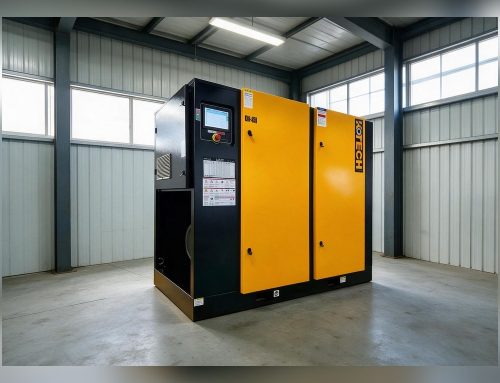
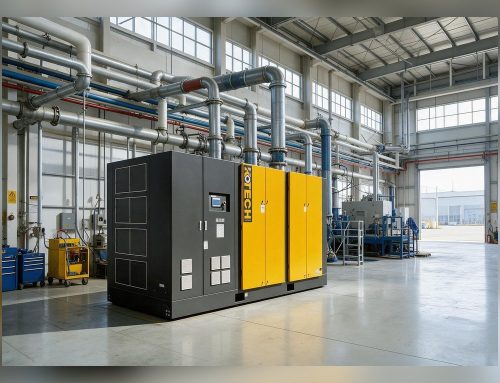
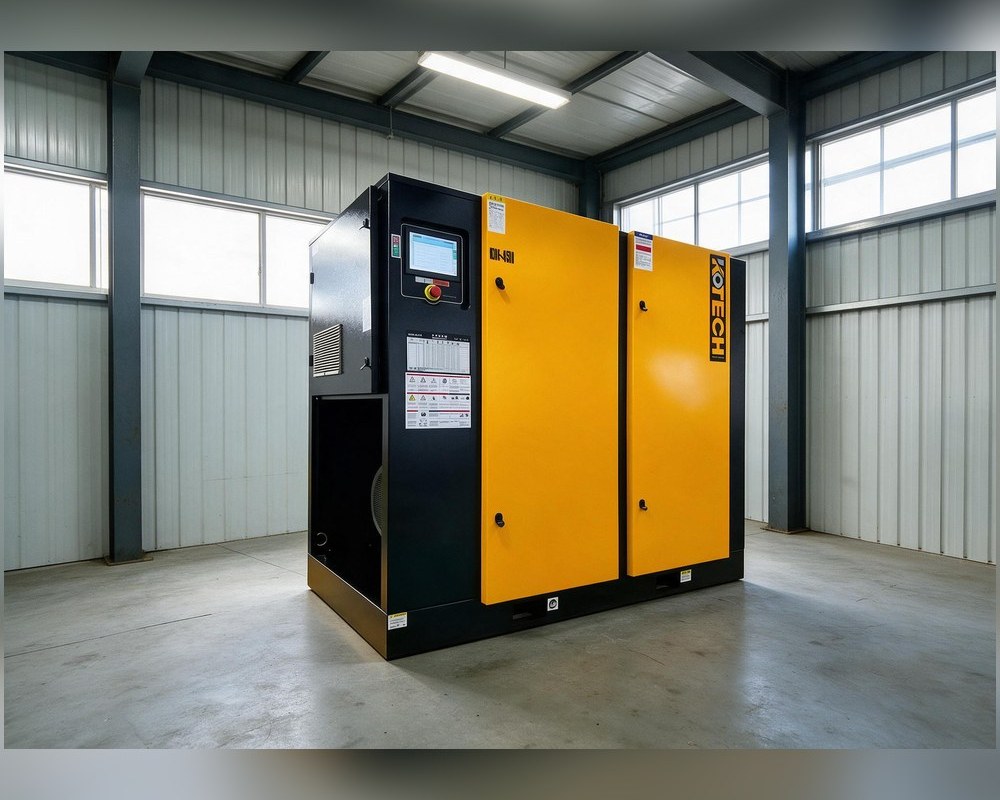
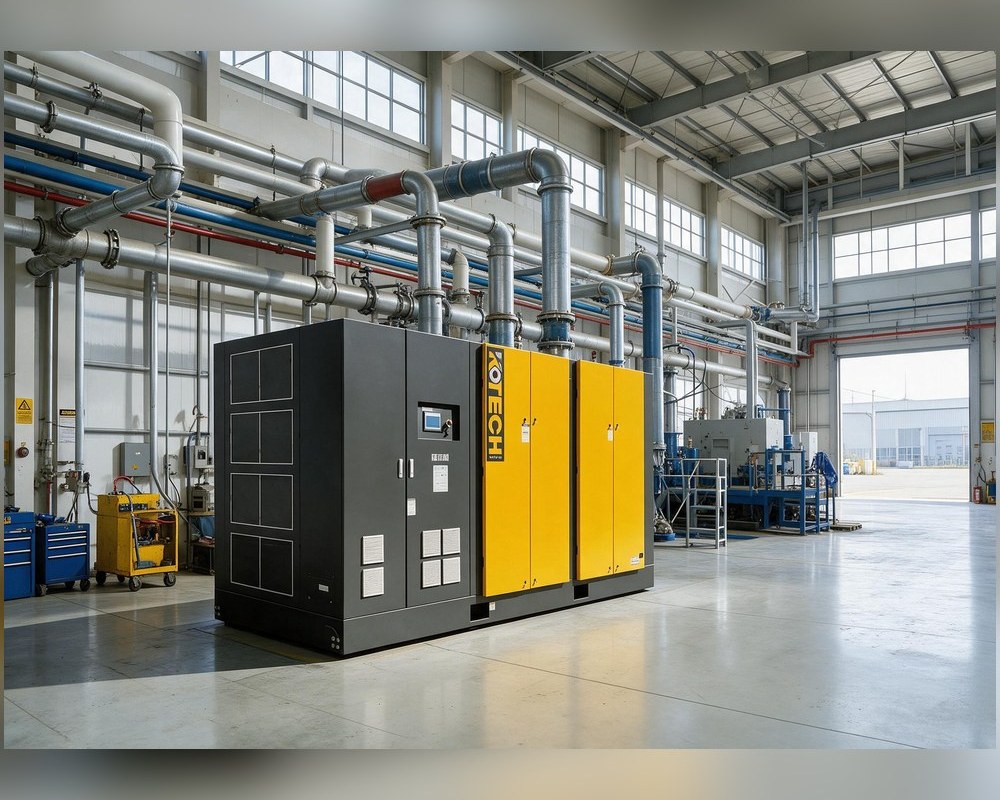
- KOTECH KOE-II series two-stage compressors fully meet ISO 8573 international air purity standards, covering mainstream pressure and flow demands across manufacturing, food processing, pharmaceutical and energy industries.
- Variable speed drive equipped two-stage units reduce no-load energy waste by 32% to 40%, which is the core cost-saving configuration for factories with fluctuating air consumption.
Introduction
Compressed air has long been regarded as the fourth essential industrial energy source after electricity, water and gas. According to official statistics released by the United States Department of Energy, compressed air system operation accounts for 12% to 19% of the total industrial power consumption in North American manufacturing plants. Many enterprise managers and mechanical engineers often make wrong purchasing decisions simply based on price or brand popularity when selecting industrial air compressors, resulting in long-term high electricity bills, frequent equipment failures and unqualified production air sources.
Different from small civilian air compression equipment, industrial-grade two-stage air compressors are designed for continuous heavy-load operation. Its two-level segmented compression structure completely changes the working logic of traditional single-stage compression, and brings fundamental improvements in energy saving, operational stability and later maintenance cost control. This practical buying guide is written based on actual industrial site application experience, combined with KOTECH official KOE-II series core product parameters and global industry recognized test data, to help industrial buyers eliminate redundant marketing information and complete scientific and accurate equipment selection from actual production pain points.
Core Working Principle of Industrial Two-Stage Air Compressors
Differences Between Two-Stage and Single-Stage Compression Structure
The biggest core difference between two-stage and single-stage compressors lies in the compression segmentation design. Single-stage compressors finish all air compression work in one airend, which will generate a large amount of concentrated heat, cause serious internal air leakage loss, and greatly reduce volumetric efficiency under long-term high-pressure operation. While standard two-stage industrial compressors adopt low-pressure primary compression plus high-pressure secondary compression mode.
After the ambient air is sucked into the first-stage low-pressure rotor for preliminary pressure rise, it will pass through a professional intercooler for sufficient cooling treatment, and then enter the second-stage high-pressure compression cavity to complete the final pressure setting output. This segmented compression mode is closer to the ideal isothermal compression state in mechanical thermodynamics, which can effectively avoid energy loss caused by excessive thermal expansion of air.
Practical Structural Advantages Verified by Industrial Tests
In long-term load comparison tests conducted by Compressed Air and Gas Institute, two-stage compression equipment shows obvious advantages in multiple core indicators. Under the same output pressure and air volume, the internal operation loss is reduced by nearly 11%, the overall equipment vibration amplitude is reduced by 27%, and the average daily failure maintenance frequency is reduced by more than half compared with single-stage products of the same power level. For industrial sites that require 24-hour uninterrupted operation, this structural advantage directly translates into stable production capacity and lower shutdown loss risks.
Pain Points Solved by Two-Stage Compressors in Actual Industrial Production
High Long-Term Power Consumption Pain Point
A large number of factory operation data show that most single-stage compressors will appear serious energy efficiency attenuation after running for more than one year. Many enterprises ignore the later power consumption cost when buying low-cost single-stage equipment in the early stage. After long-term use, the annual extra electricity expenditure far exceeds the initial equipment price difference. Two-stage compressors optimize the compression ratio distribution, maintain high energy efficiency all year round, and effectively solve the hidden cost problem of high power consumption in traditional compression systems.
Unstable Air Pressure Affecting Production Quality
In precision machining, spray painting, food filling and pharmaceutical packaging production links, tiny air pressure fluctuations will directly lead to unqualified finished products and increased product scrap rate. The two-stage compression design of KOTECH KOE-II series is equipped with precise pressure stabilizing control components, which can keep the output air pressure fluctuation within ±0.02MPa, completely adapt to the high-precision production air supply requirements, and solve the production quality hidden dangers caused by unstable air pressure for enterprises.
Short Service Life and Frequent Maintenance Troubles
Excessive concentrated heat is the main factor leading to rapid aging of compressor core accessories. The matching intercooling system of two-stage compressors can take away most of the compression heat in time, keep the internal operating temperature of the equipment in a reasonable safe range, slow down the aging speed of lubricating oil, bearings and rotor accessories, extend the replacement cycle of wearing parts, and greatly reduce the labor cost and accessory cost of daily equipment maintenance for factory maintenance personnel.
Key Quantitative Selection Standards for Industrial Two-Stage Air Compressors
1. Reasonable Confirmation of Actual Working Pressure Demand
Industrial production scenarios have clear differentiated pressure demand ranges, and blindly pursuing high pressure will cause serious energy waste. General mechanical assembly and pneumatic tool production lines are suitable for 8bar standard working pressure; food processing, textile industry and light industrial production need to configure 8bar to 10bar medium pressure models; plastic bottle blowing, high-pressure sandblasting and heavy industrial processing must select 10bar to 12.5bar high-pressure two-stage compressors.
When selecting equipment, buyers need to reserve 0.5bar to 1bar reasonable pressure margin on the basis of the maximum air pressure required by terminal production equipment, so as to avoid insufficient air pressure affecting production efficiency after long-distance pipeline transmission.
2. Scientific Calculation of Actual Air Flow Demand
It is the most common selection mistake to only refer to the nominal exhaust volume marked on the equipment nameplate. The correct calculation method of industrial actual air supply demand is to sum the air consumption of all pneumatic equipment, multiply by the equipment simultaneous utilization rate, plus 25% pipeline air leakage loss and future production expansion reserve air volume. KOTECH KOE-II series covers complete air flow specifications from 9.5m³/min to 61.9m³/min, which can accurately match the air demand of small, medium and large industrial production workshops.
3. Matching Selection of Motor Power and Driving Mode
Fixed-speed two-stage compressors are more suitable for production workshops with stable air consumption all day long, with lower initial purchase cost and simpler later maintenance. For factories with obvious peak and valley air consumption such as shift production and intermittent processing, it is strongly recommended to choose VSD variable frequency drive two-stage compressor models. Verified by actual operation data, variable frequency two-stage compressors can save nearly 38% of invalid power consumption in low-load operation state, and the energy-saving advantage is extremely prominent in multi-shift production mode.
All mainstream industrial two-stage compressors are equipped with high-efficiency IE4 grade industrial motors, which can maintain stable power output in harsh working environments such as low temperature and high dust.
4. Air Purity Grade Matching According to Industry Attributes
ISO 8573 is the most authoritative global compressed air purity classification standard, and different industries have strict access thresholds for compressed air cleanliness. Ordinary mechanical manufacturing only needs to meet Class 4 air purity standards; food processing and beverage production must reach Class 2 low-oil clean air standards; biopharmaceutical, electronic chip production and medical equipment manufacturing need to be equipped with multi-stage post-processing purification equipment on the basis of two-stage main engine to reach Class 1 ultra-clean air supply standard.
The built-in three-stage oil-gas separation system of KOE-II series can stably control the residual oil content in output compressed air below 2ppm, which can directly meet the low-oil air demand of most medium and high-standard industrial industries.
Environmental Adaptability and Durability Design Analysis
Excellent industrial two-stage compressors need to adapt to complex factory site environments. High-quality qualified products can operate stably in the ambient temperature range of -20°C to 50°C, and will not start failure or over-temperature shutdown due to extreme temperature changes. In terms of noise control, the whole machine adopts fully enclosed silent structure and large-diameter low-speed heat dissipation fans, and the operating noise is controlled within the range compliant with ISO 2151 industrial noise standards, which will not cause noise interference to on-site staff and surrounding production areas.
In terms of core component configuration, formal industrial two-stage compressors adopt high-precision imported bearings and wear-resistant alloy rotor materials. After professional dynamic balance calibration, the whole machine runs smoothly, and the design service life of the core airend can reach more than 40,000 working hours without major maintenance.
10-Year Total Cost of Ownership Assessment Method
Professional industrial equipment procurement must take total cost of ownership as the core evaluation standard, rather than simply comparing the initial transaction price. The total comprehensive cost of two-stage air compressors includes initial equipment procurement cost, annual electric energy use cost, daily maintenance and wearing parts replacement cost, and production shutdown loss caused by equipment failure.
According to the cost accounting data of North American industrial equipment research institutions, electric energy consumption cost accounts for about 75% of the total 10-year use cost of compressors. Therefore, two-stage energy-saving models with slightly higher initial price can quickly recover the early price difference through long-term electricity savings. Enterprises that focus on long-term stable operation and cost control are more suitable to prioritize high-efficiency two-stage compression equipment layout.
Reliable Supplier Selection and After-Sales Service Judgment Criteria
When confirming the procurement cooperation manufacturer of industrial two-stage compressors, buyers need to check the enterprise formal qualification certification first, including ISO 9001 quality management system certification, CE European industrial safety certification and ASME American mechanical industry standard certification. Complete qualification certificates are the basic guarantee for equipment standard production and cross-regional stable use.
In addition to product quality, perfect after-sales service system is also an indispensable selection condition. Preferred brands need to have global technical support channels, local on-site maintenance service teams, sufficient original factory spare parts inventory and standardized regular equipment inspection services. Timely after-sales response can minimize the production stop loss caused by sudden equipment failure for industrial enterprises.
Conclusion
The selection of industrial two-stage air compressors is a systematic decision related to enterprise production efficiency, production quality and long-term operating costs, not a simple mechanical equipment purchase behavior. All purchasing decisions should be based on actual production air demand data, combined with industry air purity standards, on-site environmental conditions and long-term cost planning.
Eliminate blind price-oriented purchasing thinking, reasonably distinguish the performance differences between two-stage and single-stage compressors, accurately match pressure, air flow, power and purification configuration, and select reliable products with stable performance and perfect after-sales service represented by KOTECH KOE-II series. Only in this way can enterprises establish an efficient, energy-saving and stable industrial compressed air supply system, reduce comprehensive operating costs in an all-round way, and lay a solid foundation for long-term stable production and market benefit improvement.
FAQs
1. What kind of industrial scenarios are most suitable for using two-stage air compressors?
Two-stage air compressors are the best choice for factories that need 24-hour continuous air supply, equipment power above 55KW, working pressure higher than 8bar, and industries with high requirements for compressed air cleanliness. Intermittent light-duty small pneumatic equipment can still use cost-effective single-stage compressors.
2. How much actual electricity cost can a two-stage industrial compressor save every year?
Taking a 160KW industrial compressor running 4000 hours a year as an example, calculated at the mainstream industrial electricity price in the United States, qualified two-stage energy-saving models can save more than 6400 US dollars in electricity expenses every year, and the energy-saving effect will be more obvious with longer running time.
3. Is the later maintenance difficulty of two-stage compressors higher than that of single-stage ones?
Although the internal structure of two-stage compressors is more sophisticated, due to the better internal heat dissipation environment and lower component operating load, the replacement cycle of lubricating oil, filter elements and other wearing parts is longer, and the daily routine maintenance operation is basically consistent with single-stage models. The actual later maintenance difficulty and comprehensive cost are lower.
4. Can two-stage compressors work normally in high-dust and high-humidity factory workshops?
Standard industrial-grade two-stage compressors are equipped with multi-stage air intake filtering devices and sealed anti-humidity structures. After selecting matched protective accessories, they can operate stably in high-dust mining sites and high-humidity coastal processing workshops without easy failure.
5. What post-processing equipment needs to be matched with two-stage compressors?
Ordinary industrial production only needs to be equipped with simple precision filters; industries such as food and medicine need to be matched with freeze dryers, adsorption dryers and oil removal filters to further improve compressed air cleanliness and reach the specified ISO 8573 purity grade.
6. What is the normal overall service life of industrial two-stage air compressors?
Under standardized daily maintenance and compliant load operation, the overall stable service life of formal qualified industrial two-stage compressors can reach more than 10 years, and the core airend can maintain stable performance without overhaul within 40000 working hours.