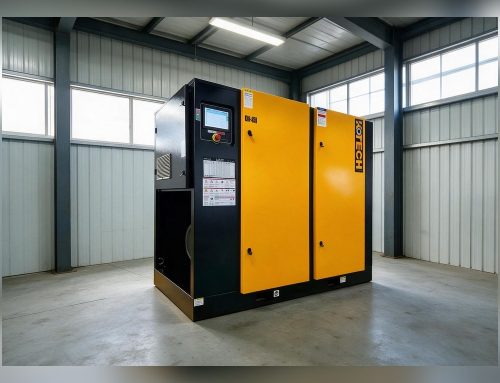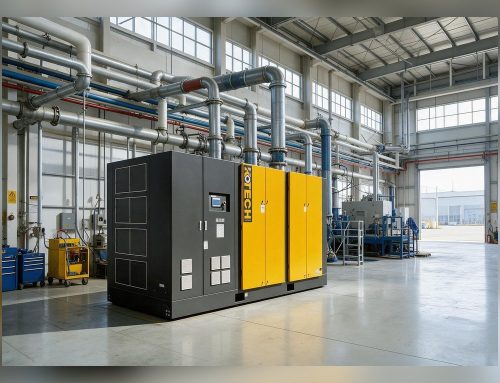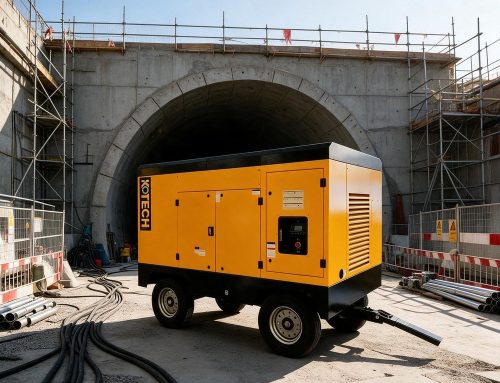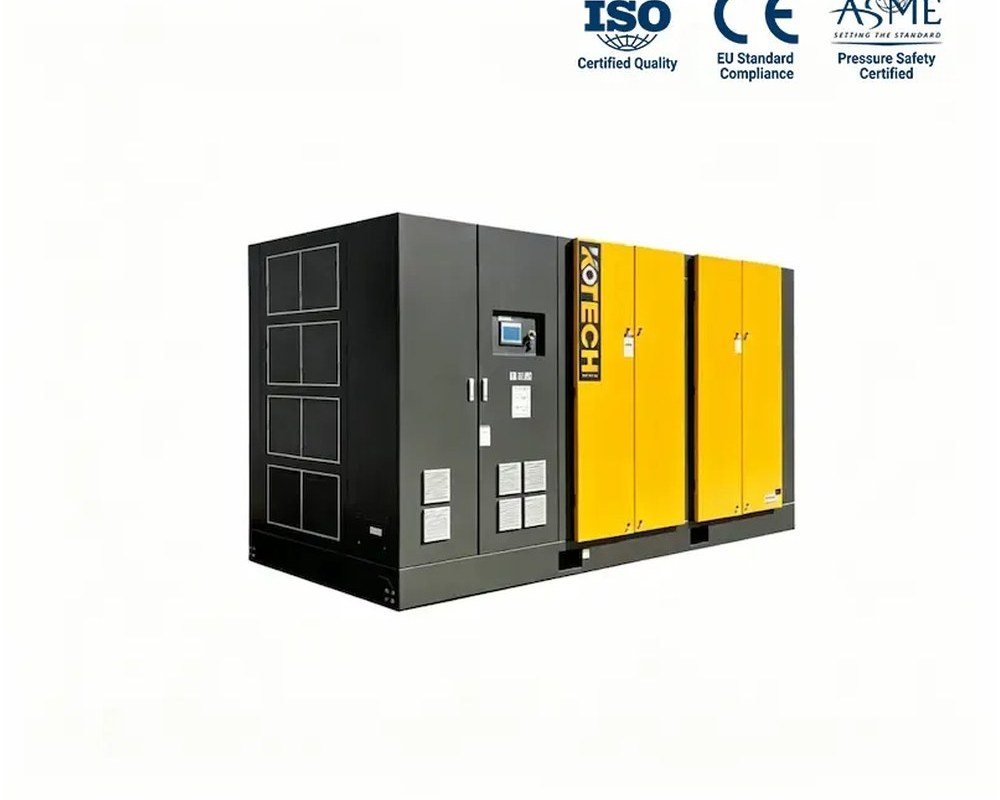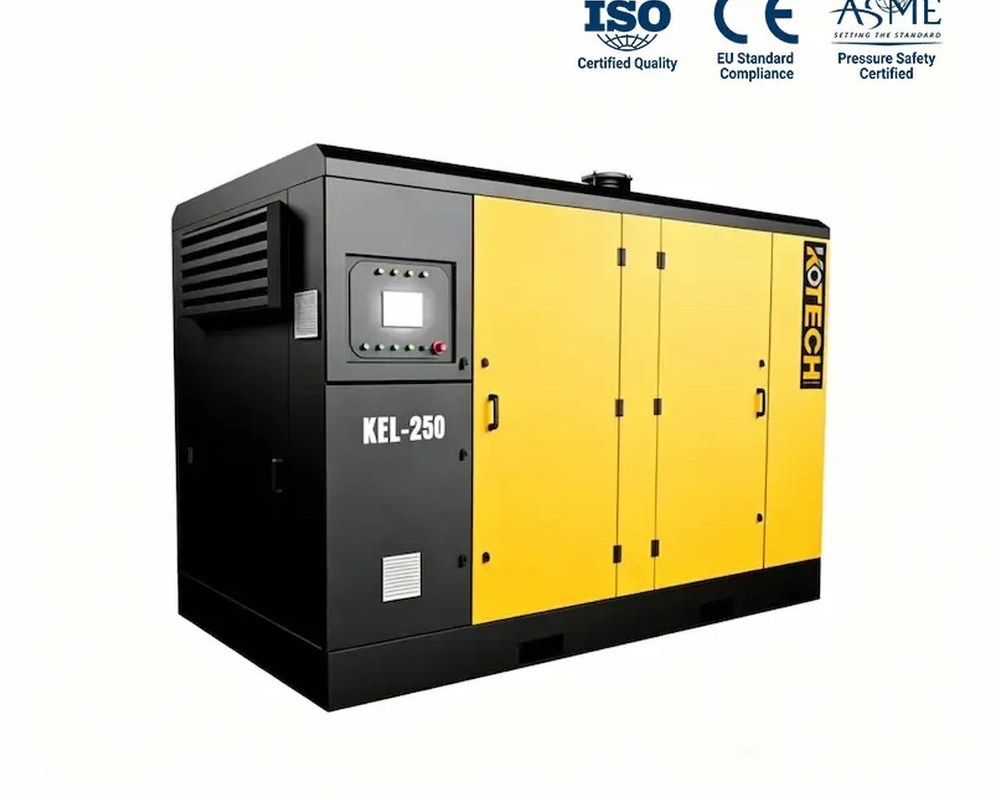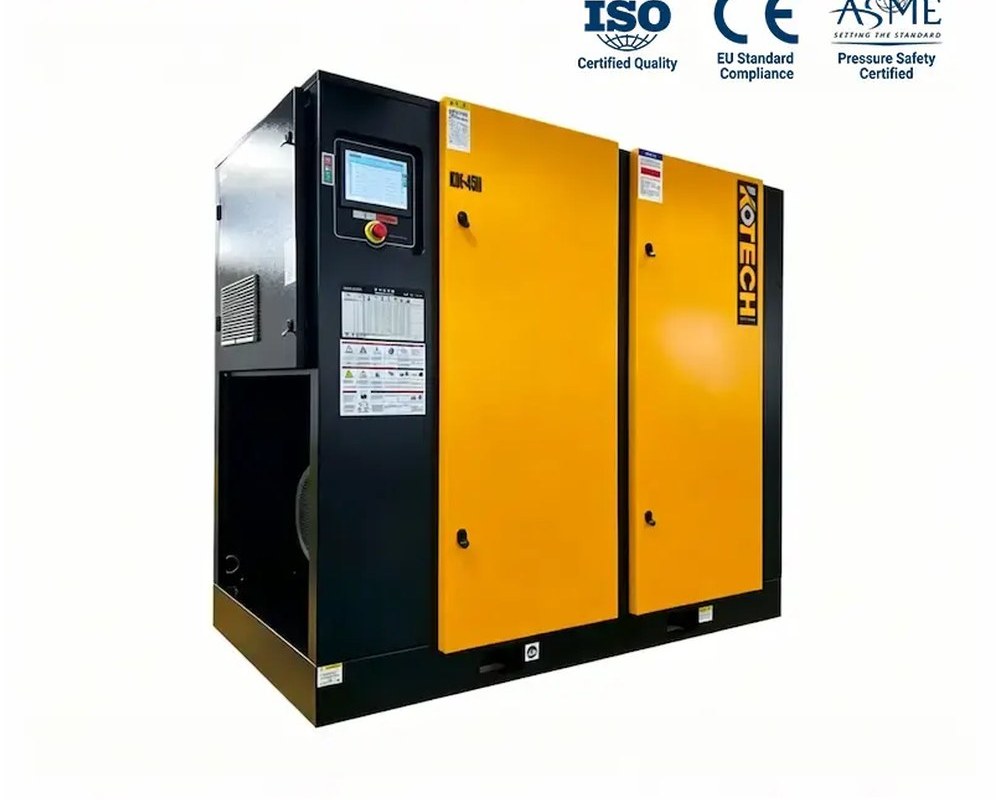




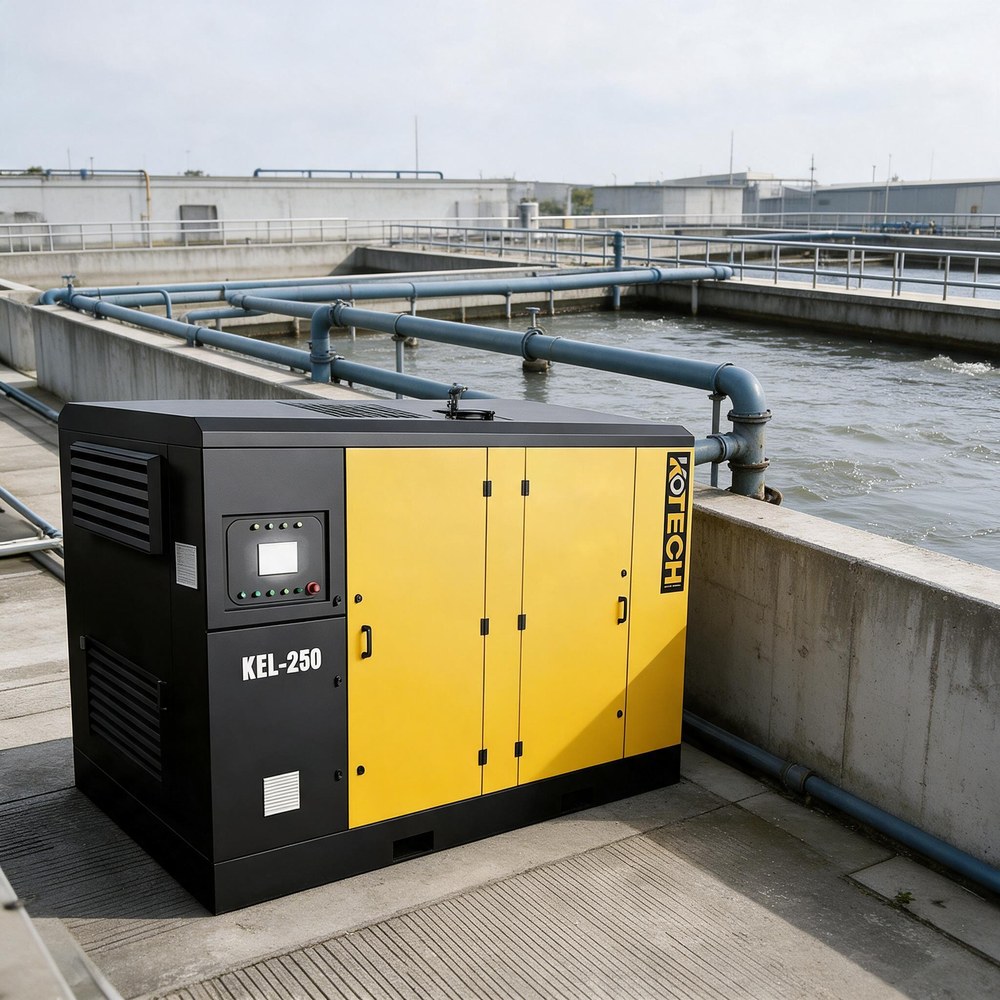
In an activated sludge wastewater treatment plant, aeration does the actual cleaning. Air blown through diffusers keeps bacteria alive and mixed, and in many plants the blowers that supply that air account for more than half of the total electricity bill. The key fact is that aeration needs a very large volume of air at very low pressure, typically around 0.5 to 1 bar at the diffuser. A low-pressure screw compressor built for that duty moves the same air with much less energy than a standard industrial compressor forced to operate far below its design pressure.
Why aeration air is different
Most factory compressed air is produced at 7 to 10 bar to drive tools, cylinders, and valves. Aeration air is the opposite: the air only has to overcome the depth of the tank, diffuser losses, and piping resistance, which together usually require well under 1 bar of pressure. What the process needs in huge quantity is volume, enough oxygen transfer to keep the biological process working across every basin.
Using a standard 7 bar compressor for this duty is inefficient because the machine and its airend are designed for a pressure ratio the process does not need. Energy is spent producing pressure that is then throttled away. A low-pressure machine is built around the real requirement and converts more of the input electricity into air that actually reaches the water.
How low-pressure screw compression works
A low-pressure screw compressor uses the same positive-displacement principle as an industrial screw machine, with rotors that trap and move a fixed volume of air each revolution, but the airend, drive, and casing are optimized for a low pressure rise and high volumetric flow. The result is a smooth, pulse-free supply suited to continuous diffuser operation.
Positive displacement also keeps delivery predictable as conditions change, and the machines can be controlled to match the oxygen demand of the basins rather than running at a fixed output. Because aeration loads shift with influent, time of day, and season, controlling air delivery is where the largest energy savings are found after choosing the right machine.
- High air volume at the low pressure diffusers actually require.
- Avoids the energy wasted by a 7 to 10 bar machine throttled down.
- Continuous, steady airflow suits biological treatment.
- Output can be controlled to match real-time oxygen demand.
Matching air supply to oxygen demand
Treatment plants rarely need the same amount of air all day. Influent load, dissolved oxygen levels, and mixed liquor conditions change continuously. Running the blowers at full output regardless of those conditions is a long-standing source of wasted energy, and many older plants were operated exactly that way.
Modern control links blower output to dissolved oxygen or ammonia measurements so air is reduced when the process needs less. Low-pressure screw machines fit well into such systems, because their delivery can be trimmed while maintaining stable pressure to the diffuser grid. This protects treatment performance, prevents over-aeration, and converts lower oxygen demand directly into lower electricity use.
- Control airflow from dissolved oxygen rather than fixed settings.
- Avoid over-aeration, which wastes power without improving effluent.
- Keep header pressure stable while delivery to basins is adjusted.
- Sequence multiple machines efficiently at low and high loads.
Real KOTECH low-pressure screw models
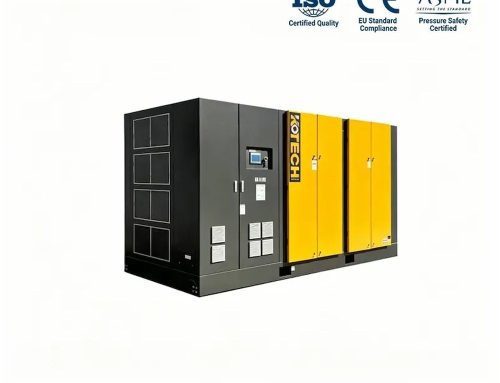
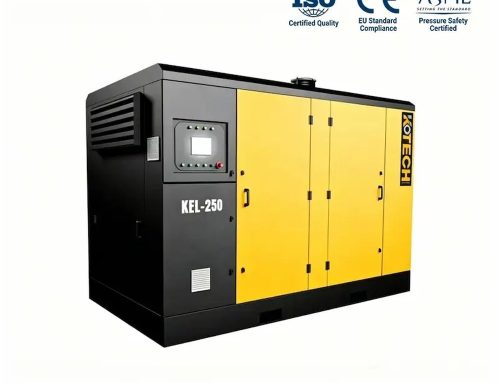
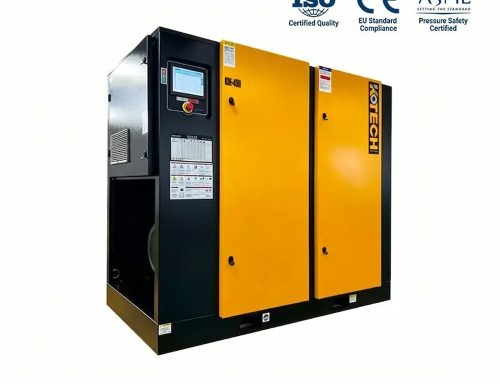
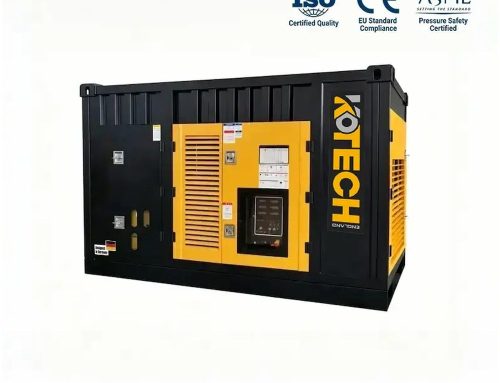
Current KOTECH low-pressure screw models with free air delivery, suction pressure, and motor power from the product page specifications.
The table lists real KOTECH low-pressure screw models with free air delivery, suction pressure, and motor power. The range covers small package plants up to large municipal aeration loads, so machines can be combined and sequenced around the basin demand.
Reliability in a treatment plant environment
Wastewater plants are humid and often corrosive, so equipment layout, intake air quality, and protection from the process environment matter. Clean intake air, adequate ventilation around the machine, and appropriate filtration protect both the compressor and downstream air quality, while monitoring discharge temperature and pressure gives early warning of fouled filters or coolers.
- Locate the intake away from humid or contaminated process air.
- Keep filters and coolers clean to protect efficiency and temperature.
- Use monitoring and alarms for pressure and temperature.
- Plan redundant capacity so a service interval does not stop aeration.
- Protect piping and components suited to the humid environment.
Energy savings and plant economics
Because aeration dominates plant energy use, even a modest improvement in air delivery efficiency has a large and lasting financial return. The savings come from two layers: choosing a machine optimized for low pressure removes the waste of over-compression, and controlling output to actual oxygen demand removes the waste of supplying air the basins do not need.
For plant operators evaluating an upgrade, the best approach is to measure the current aeration profile, dissolved oxygen control, and blower energy over time, then compare that with low-pressure machines sized to the real basin demand. In plants currently using compressed-air-style machines or fixed-output operation, the difference is often substantial and continues every hour the plant runs.
What to check when specifying aeration blowers
- Calculate the true pressure needed for tank depth, diffusers, and piping.
- Size flow from the maximum oxygen demand, not from a standard compressor.
- Plan dissolved oxygen control so output follows the biological load.
- Sequence multiple machines for efficient low-load operation.
- Protect machines from the humid, corrosive plant environment.
- Keep redundancy so aeration continues during maintenance.
Frequently asked questions
What pressure is needed for wastewater aeration?
Why not use a standard 7 bar air compressor for aeration?
How much energy does aeration use in a treatment plant?
Can blower output change when oxygen demand is lower?
What causes over-aeration?
How many blowers does a treatment plant need?
If you are upgrading aeration at a treatment plant or designing a new facility, KOTECH can size low-pressure screw machines and a control strategy around your basin demand.