



In an air-jet weaving shed, compressed air is the weft insertion medium itself: every pick rides a controlled jet from main and relay nozzles across the warp, so pressure stability, air cleanliness and dryness directly affect fabric quality, stop marks and machine efficiency. The load is rarely steady — each loom’s demand pulses with the insertion cycle, total demand shifts with style changes and the number of looms running, and electricity for compressed air routinely accounts for a large share of a mill’s energy bill. A permanent-magnet variable-speed (PM VSD) screw compressor station, sized around the real demand band, cuts both energy cost and pressure fluctuation. This guide explains how to size such a station, with current KOTECH KOE PM VSD figures.
What air-jet weaving demands from the air system
An air-jet loom uses a main nozzle to launch the filling yarn and a sequence of relay nozzles across the reed to carry it through the shed. Each insertion is a short, high-frequency pulse; hundreds of looms running together create a total demand that oscillates continuously rather than holding flat. Loom manuals specify a narrow pressure band at the machine — commonly around 5 to 7 bar depending on yarn type, loom model and width — because too little pressure causes mispicks and short picks, while excess pressure wastes air and can disturb the warp. Set pressure must therefore be stable at the looms, accounting for losses through treatment equipment and piping.
Air quality is equally important. Moisture in the air changes yarn behaviour, encourages corrosion in the loom’s precision valves and nozzles, and can cause weft stops in delicate styles; particulates and oil residues foul relay-nozzle profiles. Mills therefore treat the air through drying and filtration trains designed for the yarn range, with instrument-grade cleanliness at the machines. The compressor station has to deliver this treated air at stable pressure across the whole shed, from the first loom to the end of the longest air main, at the lowest possible energy cost.
- Stable pressure at the looms prevents mispicks, short picks and stop marks.
- Demand pulses with every insertion and shifts with style changes and looms in service.
- Dry, clean air protects precision relay nozzles and sensitive yarns.
- Compressed air is one of the largest electricity loads in a weaving mill.
Why PM VSD drive fits the weaving load profile
A fixed-speed screw compressor runs at one output and modulates by loading and unloading, which is efficient only near full load; at part load it cycles, idles and bleeds the receiver, and energy per cubic metre rises sharply. Air-jet sheds rarely stay at full load for long: beam changes, style changes, shifts and maintenance continuously vary the number of active looms, and even at steady production the insertion pulses keep demand moving within a band. A VSD compressor varies rotor speed to track that demand, delivering only the air the header needs while holding a nearly constant discharge pressure — usually within a fraction of a bar — instead of swinging between load and unload set-points.
Permanent-magnet motors raise the part-load efficiency further, especially at low speeds, and modern PM VSD machines maintain good efficiency across a wide turndown. The standard station design for a medium or large mill is a mix: one PM VSD trim compressor that follows the variable part of the load, plus fixed-speed base-load machines that run flat-out when the shed is full, all sequenced against a common receiver. That combination keeps every machine near its best efficiency point across the working week, rather than running one oversized VSD unit at low speed continuously, which wastes its own auxiliary power.
Real KOTECH KOE PM VSD specifications
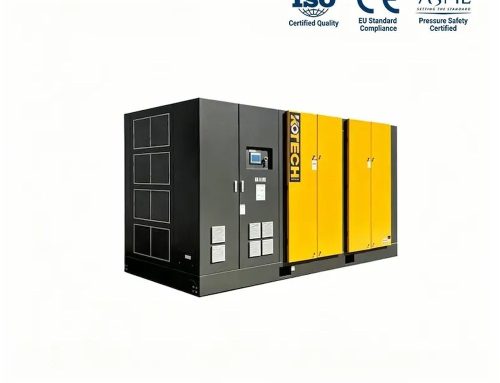
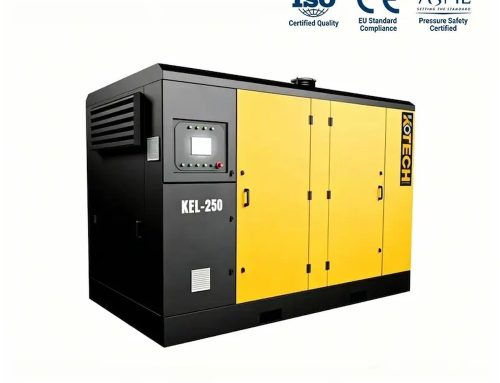
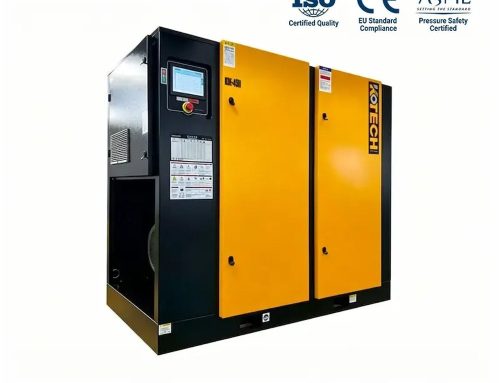
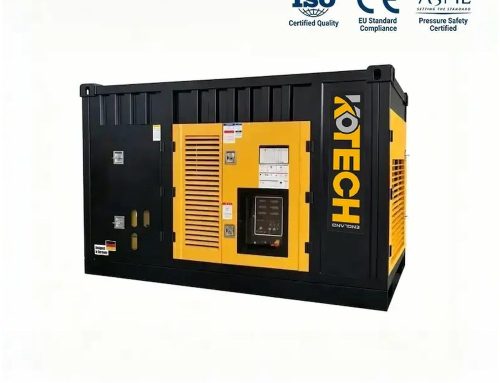
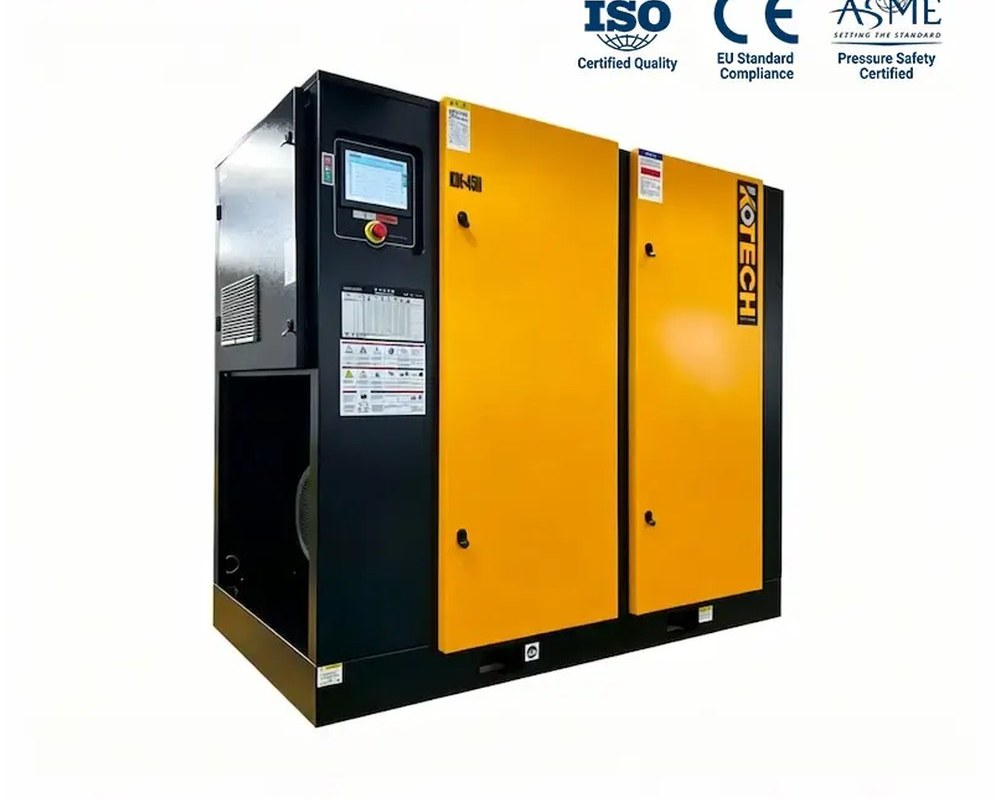
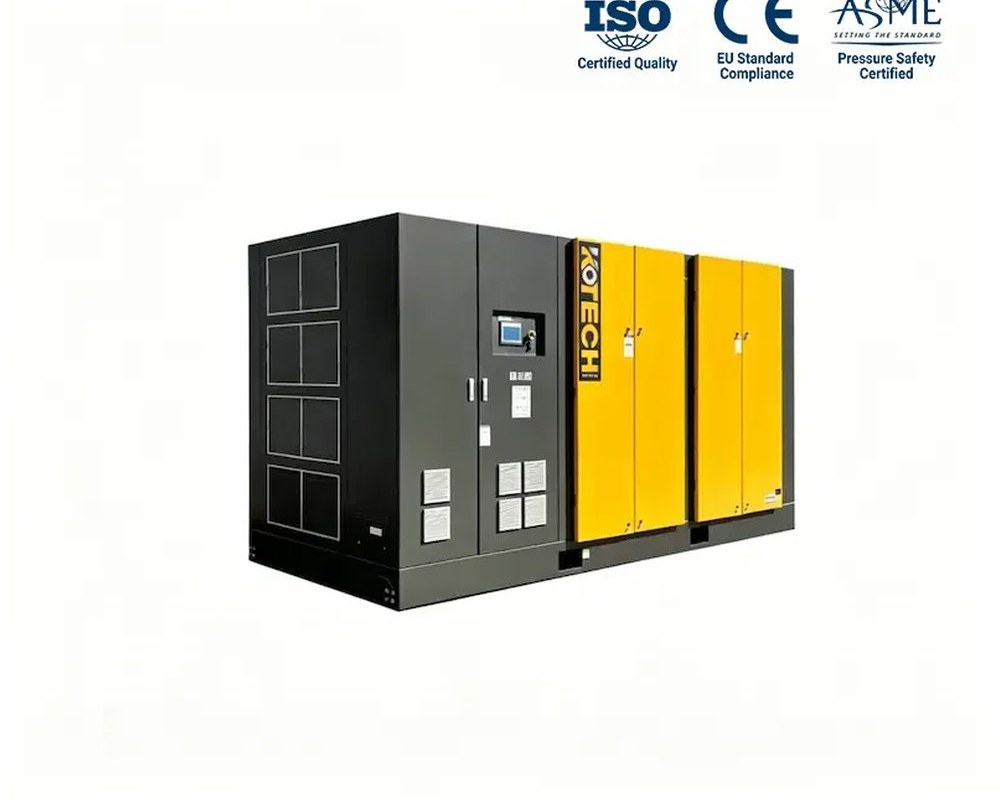
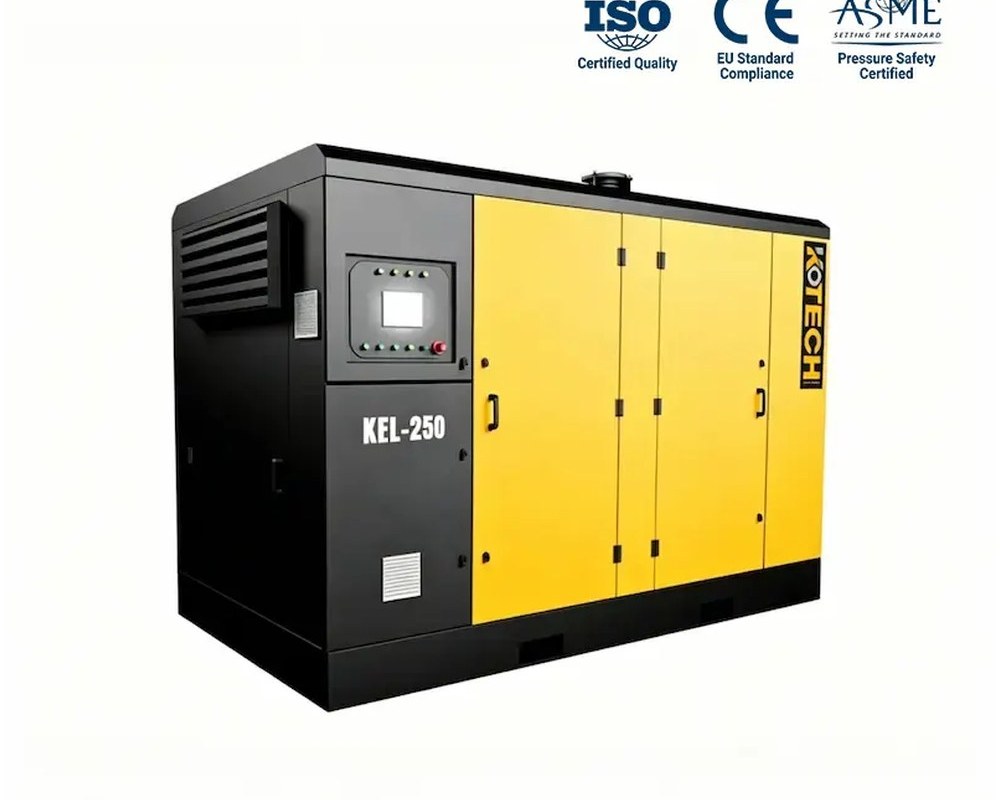
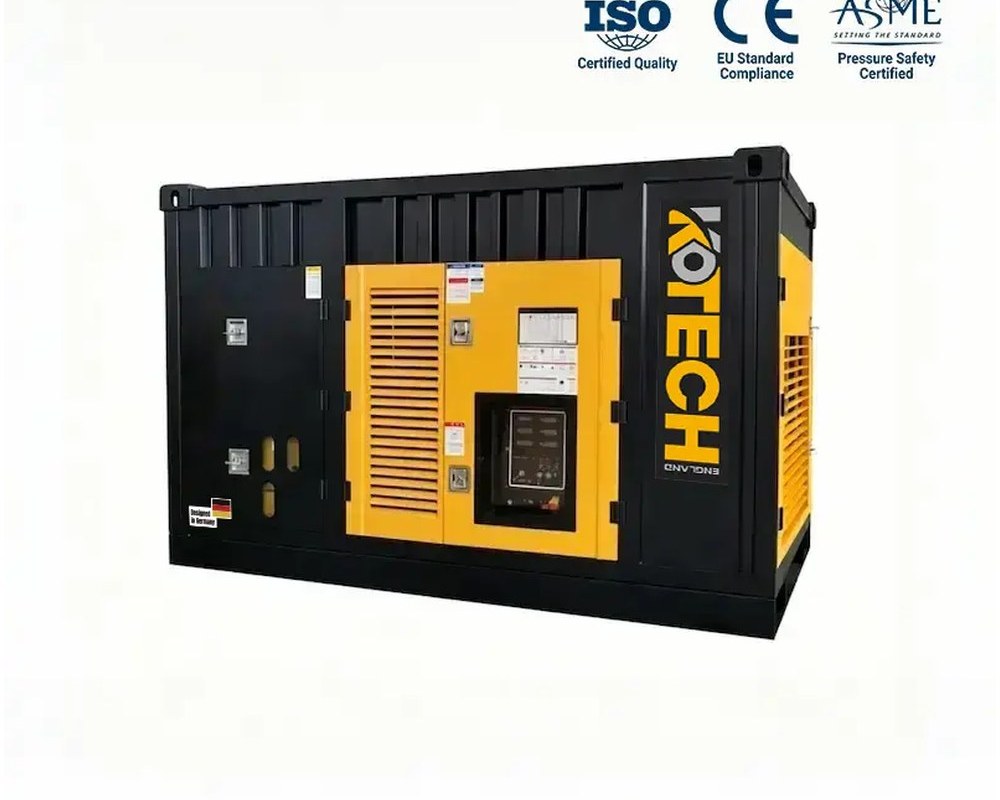
Current factory figures at 10 bar from the KOTECH product page; free-air delivery is a variable-speed band that rises at 7.5 bar and falls at 13 bar.
Read the flow band at the pressure you actually run: a KOE-110VSD delivers 10.17 to 22.6 m³/min at 7.5 bar but 8.55 to 19 m³/min at 10 bar. Specifying a 10 bar machine for a 5.5 bar loom header wastes both capital and energy; instead minimise header set pressure and pipe losses so the smallest adequate rating serves the shed.
Sizing and station design procedure
Begin with an air audit rather than a catalogue estimate. Log header pressure and compressor power for at least a week covering all shift patterns and a style change, and survey leakage with an ultrasonic detector — weaving sheds commonly leak 15 to 30 percent of production through aging couplings and hose tails, and fixing leaks is cheaper than buying compressors. From the demand profile choose base-load capacity for the steady minimum-to-high range and one PM VSD trim machine covering the swing, with an N+1 arrangement so a machine can be serviced without stopping looms. Receiver volume should be sized to smooth the collective pulse so the VSD unit is not chasing fast millisecond fluctuations directly.
Pressure strategy matters as much as machinery. Set the compressor discharge only as high as the worst-case path — dryer, filter, main and ring losses plus the loom requirement — demands, and design the ring main as a loop with adequate diameter so pressure at the furthest loom stays within the maker’s band. Treatment should include a dryer sized for the local climate and yarn range, with appropriate particulate filtration; humid coastal mills may need a lower dew point than dry inland sites. Heat rejected by the compressors can be recovered for sizing-room heating or process hot water, improving the overall energy balance.
Reliability, controls and life-cycle cost
Weaving runs on continuous production, so the compressor house should be treated as process-critical equipment. Specify machines with remote monitoring, run-hour and temperature trending, and automatic rotation equalising service intervals across the station; the KOE control system supports multi-unit linkage so base and trim machines sequence without manual intervention. Plan intake air from a clean, cool source — cooler intake directly raises mass flow per kilowatt — and keep the compressor room ventilated for the local summer climate.
When comparing offers, build the economics around total cost over seven to ten years, where energy dominates. A slightly higher investment in PM VSD trim capacity, leak repair and correctly sized piping normally returns quickly through lower kWh per metre of fabric and fewer weft stops. As the shed expands, add compressors in sequenced steps rather than replacing the station, keeping one variable machine to trim whatever the new total demand becomes.
Buying tips
- Run a week-long demand and leak audit before sizing; weaving sheds often leak 15 to 30 percent.
- Use one PM VSD trim compressor plus fixed-speed base-load units sequenced together.
- Specify header pressure from the furthest loom’s real requirement and design the air main as a loop.
- Size the dryer and filtration for the local humidity and the sensitivity of the yarn range.
- Compare offers on 7 to 10 year energy cost; recover rejected heat where sizing rooms need warmth.
Frequently asked questions
What air pressure do air-jet looms need?
Why is a VSD compressor recommended for air-jet weaving?
How big a compressor does a weaving shed need?
Does humidity in a weaving mill matter for compressed air?
How much compressed air is wasted through leakage in weaving?
Should a mill buy one large VSD compressor or several smaller units?
Send us your air-demand audit, loom count and types, header pressure and climate conditions, and our engineers will size a KOTECH KOE PM VSD station — base load, trim, treatment and redundancy — for the weaving mill.