



Diesel Air Compressor Alternatives: How to Choose the Right Portable Compressor
Comparing diesel air compressor alternatives? Use this checklist to choose by CFM, pressure, engine options, mobility, and serviceability—then shortlist the right KOTECH KDP configuration for your jobsite.
Quick Answer
Compare diesel air compressor alternatives by requirements vs specs. Start with pressure and airflow, then verify engine preference, mobility, filtration, noise, and service access.
1) What “Diesel Air Compressor Alternatives” Really Means
Buyers look for a comparable spec match, a more serviceable fleet choice, or a better-fit configuration for jobsite conditions—not just a brand name.
- Comparable spec match: same CFM & pressure, similar footprint and noise
- Serviceability: easier maintenance, accessible consumables, practical support
- Configuration fit: skid vs trailer, engine preference, filtration choices
- Procurement path: distributor support and clear B2B quoting
2) Quick Buyer Checklist (Before You Compare Brands)
Air requirements
- Working pressure: 7 / 10 / 12–14 / up to 20 bar (100 / 145 / ~175–203 / up to ~290 psi)
- Airflow demand: total required CFM (or m³/min). Add 10–20% margin for peak loads.
Jobsite conditions
- Ambient temperature range, cold starts, altitude
- Dust level (filtration and cooling design matter)
- Continuous duty vs intermittent use
Mobility & fleet ownership
- Skid vs trailer, towbar needs, braking requirements
- Engine preference (parts availability in your region)
- Consumables availability: air filters, oil filters, separators
3) Common Diesel Air Compressor Alternatives Buyers Compare
In the global B2B market, buyers often compare brands such as Sullair, ELGi, DENAIR and others. Across brands, the decision usually comes down to verifiable criteria:
| Criteria | What to verify |
|---|---|
| CFM & pressure coverage | Model range, performance at rated pressure, stability under load |
| Engine options | Preferred brands, parts/service availability, configuration by market |
| Hot/cold operation | Designed ambient range, cooling capacity, cold-start practicality |
| Fuel tank & shift runtime | Tank capacity and typical runtime (model-dependent) |
| Filtration & durability | Dust protection design, filtration layout, maintenance intervals |
| Serviceability | Access panels, daily checks, consumables replacement time |
| Mobility | Skid/trailer options, towbar/brake options, lifting points |
Note: specifications vary by model and configuration. Always confirm final specs on the official quote/datasheet.
4) Why Many B2B Buyers Shortlist KOTECH KDP
- Designed for harsh climates: ambient range from -20°C to +50°C.
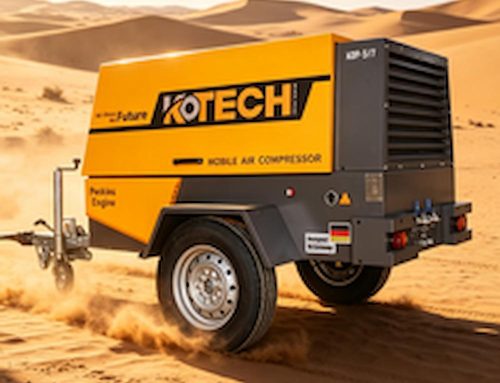
- Configurable diesel engines: options can include Kubota / Yanmar / Perkins / Volvo / Cummins (model/config dependent).
- Separate filtration: separate air filters for engine and compressor to support dependable operation in dusty sites.
- Long-shift practicality: larger fuel tank capacity options (model-dependent).
- Easy operation & protection: user-friendly controls plus automatic monitoring/shutdown in case of malfunction.
- Flexible mobility: skid or trailer configurations; towbar and braking options depending on setup.
5) KDP Model Range Overview (Examples)
Below are example specs from the KDP lineup. For exact configuration (engine, chassis, options), request the latest datasheet.
Common 7 bar / 100 psi options
| Model | Air Delivery | Pressure |
|---|---|---|
| KDP-1/7 | 1 m³/min (35 cfm) | 7 bar (100 psi) |
| KDP-2/7 | 2 m³/min (70 cfm) | 7 bar (100 psi) |
| KDP-3.5/7 | 3.5 m³/min (123 cfm) | 7 bar (100 psi) |
| KDP-4.5/7 | 4.5 m³/min (147 cfm) | 7 bar (100 psi) |
| KDP-5/7 | 5.2 m³/min (185 cfm) | 7 bar (100 psi) |
| KDP-10/7 | 10 m³/min (353 cfm) | 7 bar (100 psi) |
Higher-pressure examples
- KDP-6/10: 6 m³/min (214 cfm) @ 10 bar (145 psi)
- Up to 20 bar options: available in the KDP lineup (final airflow depends on model)
Noise and fuel tank capacity vary by model (typical noise range: ~70–80 dB(A); tank: 20–140 L).
6) Choose by Application
Construction & pneumatic tools
Most jobsite tools operate around 7 bar / 100 psi. Choose airflow based on tool count and peak demand, then add 10–20% margin for stability.
Sandblasting
Airflow stability is critical. Share nozzle size and target pressure and we’ll recommend a KDP configuration and advise on filtration/after-treatment planning.
Road works & demolition
Prioritize mobility, durable filtration design, and shift runtime (fuel tank capacity).
Rental fleets
Focus on simple operation, protection shutdowns, and service-friendly layout to reduce downtime in fleet use.
7) FAQ
What is a diesel air compressor?
A diesel air compressor is a portable compressor powered by a diesel engine—ideal for sites without stable electricity and for continuous outdoor duty.
How do I size a diesel air compressor (CFM & pressure)?
Start with your tools’ required working pressure and total airflow. Add 10–20% margin to prevent pressure drops when loads spike or multiple tools run.
Diesel compressor vs generator + electric compressor: which is better?
Diesel engine-driven compressors are integrated systems optimized for field output and durability. Generator + electric setups add components and complexity. For heavy outdoor work, dedicated diesel portable compressors are often simpler to deploy.
Skid vs trailer: what should I choose?
Skid versions work well for stationary sites or mounting on vehicles/frames. Trailer versions are better for frequent relocation. Tell us your usage and local transport rules and we’ll recommend the right setup.
How do I get service and spare parts?
You can use “Find a Distributor” for local support, and request recommended consumables/spare parts lists based on your model and usage.
Ready to shortlist your best alternative?
Click “Get a Quote” and share your required pressure, airflow, and application. We’ll propose the best-fit KDP model and configuration.