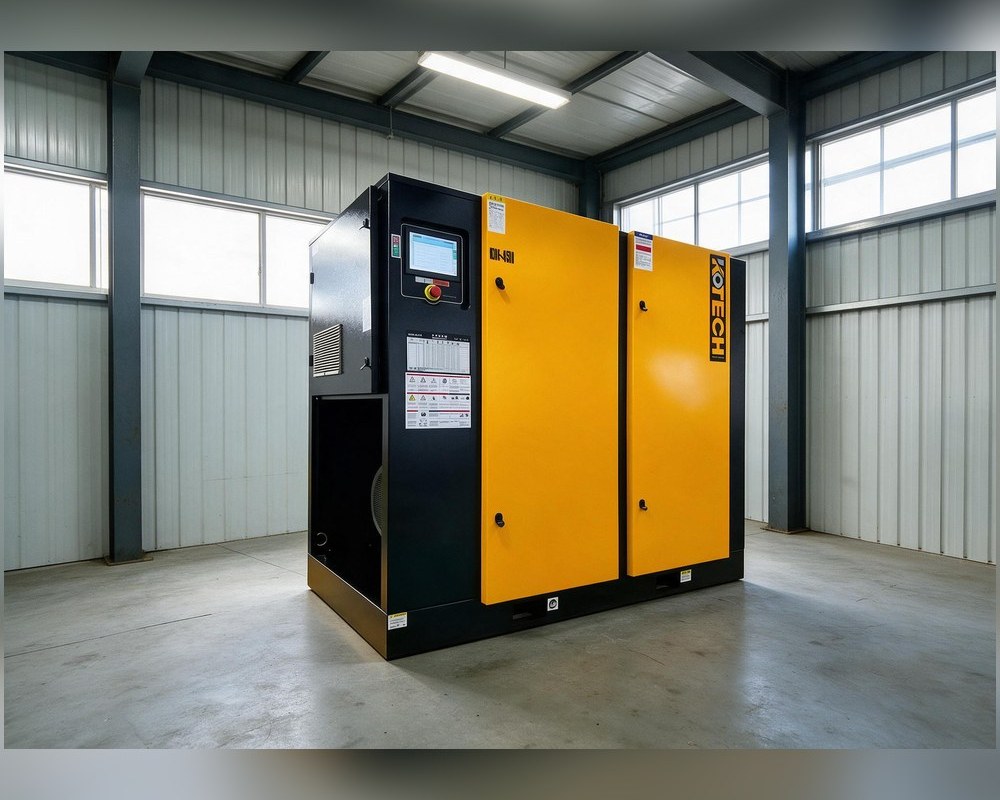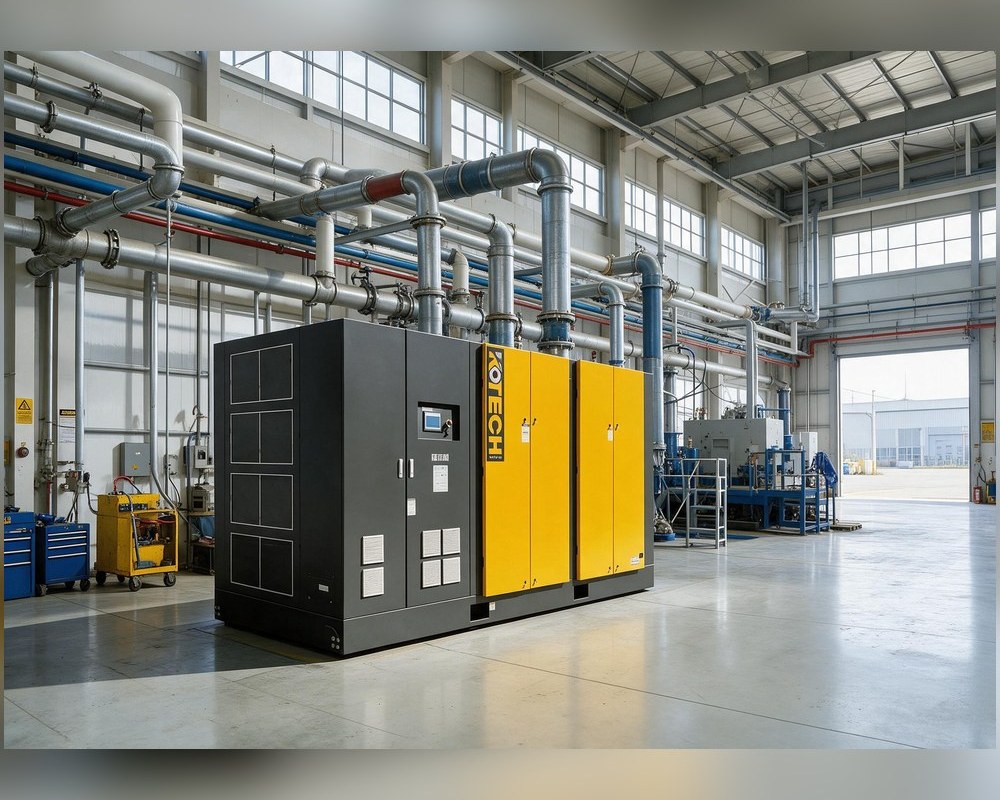




Diesel Driven Air Compressor for Middle East Jobsites: Towable vs Skid + Quick CFM Guide (7–10 bar)
On many Middle East projects, the compressor decision isn’t made in an office with perfect utilities—it’s made on a site where power is still being arranged, work fronts move, and the day’s schedule depends on whether air is available right now. In that context, a diesel driven air compressor is usually requested for one reason: you need predictable compressed air output without relying on grid power.
Typical messages we see from outdoor project teams sound like:
- “Need 7 bar, 375 cfm, outdoor, 45°C.”
- “Towable preferred, moving every 3 days.”
- “Dusty site, long running hours, need stable air for tools.”
This guide is written for that reality. It focuses on deployment decisions (towable vs skid) and how buyers shortlist common CFM ranges (185/375/400)—then shows the fastest way to request a practical configuration recommendation.
What “diesel driven” means in a compressor RFQ (and what it does not mean)
In RFQs, “diesel driven” usually means the compressor is engine-driven and self-contained—built to deliver air on-site where electricity is limited, unstable, or not worth the setup time for temporary projects.
What it does not automatically mean:
- It does not guarantee the unit is “bigger” or “higher pressure.”
- It does not guarantee the same output in every condition (heat and altitude still matter).
- It does not replace the need to confirm two basics: working pressure and airflow (CFM).
If your project language says “diesel driven,” the next step is almost always: decide how you’ll deploy it (towable vs skid) and confirm the CFM range that matches your tool package and work hours.
“Driven” vs “Powered” vs “Diesel engine air compressor” (quick clarification)
Buyers often use these terms interchangeably. Selection logic is usually the same, but the focus changes:
-
If you want a broader selection overview and jobsite sizing logic, see this
diesel powered air compressor guide -
If you want a more technical breakdown of how the package works and which specs matter, see this
diesel engine air compressor (how it works & key specs)
This article stays practical: deployment choice + common CFM shortlisting for Middle East outdoor work.
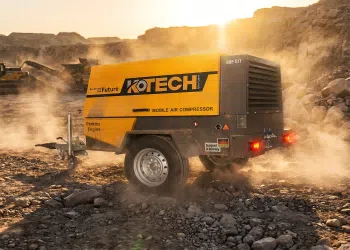
Why diesel-driven is often chosen in Middle East outdoor projects
Heat and dust turn “downtime” into real cost
When ambient temperature is high, the “lowest purchase price” option can become the highest operating cost if it can’t maintain stable output day after day. On many sites, the most expensive part of downtime isn’t the machine—it’s the schedule impact on crews, equipment, and sequencing.
A buyer’s question that matters more than brochures is:
- “Will it keep running steadily in our temperature and dust conditions?”
Off-grid power isn’t a detail—it’s a schedule risk
Pipeline spreads, roadwork, and construction fronts don’t always have power finalized early. Even when a generator is available, planning and maintaining a “generator + electric compressor” setup adds logistics, components, and failure points.
If your jobsite priority is fast deployment and consistent air availability, diesel-driven simplifies the dependency chain.
Why 7–10 bar covers most jobsite tools (and where it doesn’t)
For many outdoor tool packages, 7–10 bar is the common operating window. The more frequent problem is not pressure—it’s airflow (CFM) under real loading and duty cycle.
If you only specify pressure (for example “7 bar”) but not CFM, you’ll often end up with either:
- Pressure stability issues when multiple tools run, or
- A unit that is oversized for the actual package.
Towable vs skid: how project teams decide (the part that avoids expensive mistakes)
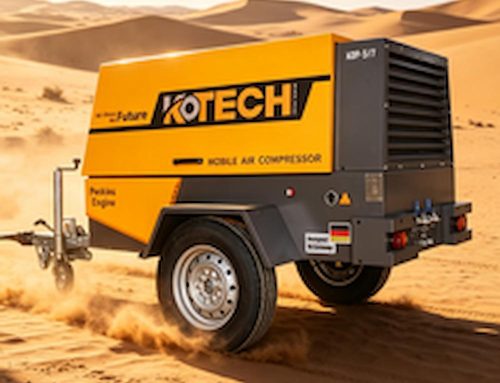
Both formats can work well. The right choice is usually about mobility pattern and site integration, not about a single “best” answer.
Choose towable when relocation speed is the KPI
Towable often makes sense when:
- Work fronts move frequently (every few days / weekly).
- You need a unit that can be positioned quickly with minimal handling.
- You want a setup that rental fleets and contractors can deploy repeatedly with consistent routines.
A practical way to think about it:
- If your crew loses time each time the compressor moves, towable can pay for itself by reducing friction.
Typical towable-style RFQ language:
- “Moving between sites frequently, need quick setup.”
- “Contractor job, relocation is common.”
Choose skid-mounted when the unit is staged or integrated
Skid-mounted often makes sense when:
- The compressor will stay in a staged location for longer periods.
- You plan truck-mounting or fixed-position operation.
- Service access, maintenance workflow, and integration into the work area matter more than daily movement speed.
Skid tends to fit project-style operations well:
- Pipeline staged sites
- EPC temporary installations
- Projects where the compressor becomes part of a semi-fixed workflow
Typical skid-style RFQ language:
- “Unit stays staged for weeks.”
- “Truck-mounted preferred.”
- “Need maintenance access and consistent operating routine.”
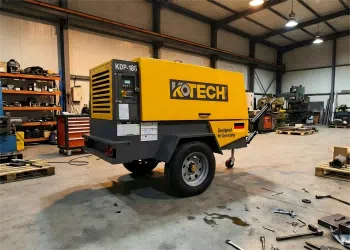
Quick decision table (keep it simple)
Towable vs Skid: Quick Decision Table (Middle East Outdoor Projects)
| Decision factor | Towable often fits when… | Skid often fits when… |
|---|---|---|
| Relocation frequency | Frequent moves (every few days / weekly) | Mostly staged (stays in one area for weeks) |
| Setup friction | Fast “arrive → connect hoses → start” matters | Planned setup is acceptable (lifting / mounting / staging) |
| Site access & handling | Easy towing and positioning on changing work fronts | Forklift/crane/truck integration is available and expected |
| Maintenance workflow | Contractor-style routines; quick checks between moves | Service access is planned (filters/cooling cleaning space) |
| Integration needs | Standalone jobsite unit with minimal site integration | Part of a staged project workflow (pipeline/EPC/truck-mount) |
| Typical buyer profile | Contractors / rental fleets / roadwork teams | Project EPC / pipeline staged sites / long-hour operations |
If you tell a supplier how often you move and how many hours per day you run, you’ll usually get a faster and more accurate recommendation than if you only send pressure.
Quick CFM shortlist (common Middle East searches): 185 / 375 / 400 CFM at 7–10 bar
Many buyers start from CFM because it’s how packages are discussed internationally—especially for portable, jobsite-driven decisions. In our experience, these ranges show up repeatedly in outdoor projects.
185 CFM (common search)
185 CFM often appears when:
- The air package is relatively compact
- The project wants a practical, mobile setup
- The goal is stable day-to-day output for a defined tool scope
If your RFQ starts with “185 CFM,” make sure you also include:
- whether tools will run simultaneously
- expected duty hours/day
- site temperature range
Because the difference between “works on paper” and “works on site” is often continuous operation in heat.
375 CFM (common search)
375 CFM tends to be requested when:
- The package grows beyond a single small-use case
- Multiple points of use or longer duty cycles are expected
- The team wants a buffer to reduce pressure drop risk when reality deviates from the initial plan
This is also a range where buyers frequently underestimate the effect of:
- simultaneous hoses
- real duty cycle
- site conditions (heat and dust)
If you’re asking for 375 CFM, it’s worth specifying:
- whether output stability matters more than peak output
- whether you want towable or skid (or truck-mount)
400 CFM (common search)
400 CFM is often searched when:
- the project team wants “one step up” from mid-range without moving into large staged systems
- outdoor conditions and longer daily operation are expected
- the buyer wants comfortable margin in a common jobsite pressure range (often 7–10 bar)
The best RFQs in this range include:
- operating hours/day
- whether the unit needs to be moved frequently
- temperature and altitude (even a rough range)
What about larger requirements (up to 1600 CFM)?
If your project is moving into much higher airflow, the conversation typically shifts from “portable convenience” to “project stability”—cooling margin, filtration reality in dust, and staged deployment planning become more central.
If you’re anywhere above the common ranges, include:
- whether the unit is staged or relocated
- whether multiple tools/processes run simultaneously
- whether aftercooling/drying requirements exist

Next step: get a practical KDP configuration recommendation (towable or skid)
If you’re buying for Middle East outdoor projects, the fastest way to avoid wrong-model back-and-forth is to send a short RFQ with only the fields that actually change the recommendation.
Start here to view the product range and configuration direction:
KDP Series portable diesel air compressor options (7–10 bar range)
A good recommendation should be based on:
- pressure + airflow
- duty cycle
- site temperature/dust
- altitude
- towable vs skid preference
RFQ mini-checklist (copy/paste)
Application: [construction / pipeline / drilling / blasting / tools]
Working pressure: [__ bar / __ PSI] (common jobsite: 7–10 bar)
Target airflow: [__ CFM] (common searches: 185 / 375 / 400 CFM)
Duty hours/day: [] continuous or intermittent
Site conditions: temperature [ °C], dust level [low/medium/high], altitude [__ m]
Mobility: [towable / skid / truck-mounted], destination country: [__]
If you send the above, you’ll usually get a faster and more accurate configuration recommendation than if you only send a brochure-style request.
FAQ (diesel driven + deployment focused)
What does “diesel driven” mean in a compressor RFQ?
It typically means the compressor is engine-driven and self-contained—chosen to avoid dependency on grid power and reduce deployment complexity on outdoor projects.
Diesel driven vs diesel powered: is there any practical difference for jobsite buyers?
In many RFQs, they’re used interchangeably. What matters more is the actual requirement: pressure, CFM, duty cycle, and whether the unit is towable or skid/staged.
Towable vs skid: which one is easier to maintain in dust-heavy sites?
Both can be maintained well if service access is planned. In practice:
- Towable often follows contractor-style routines and frequent moves.
- Skid often suits staged operation where maintenance access and workflow are planned as part of site setup.
Is a diesel driven air compressor affected by altitude?
Yes. As altitude increases, air density drops and engines can derate, which can affect real output. If your site is at elevation, include altitude in your RFQ so model selection includes practical margin.
Should I start from pressure (bar) or airflow (CFM)?
For most jobsite packages in 7–10 bar, CFM is usually the sizing bottleneck. Start with both if possible, or provide your tool list + quantity + duty cycle and ask for a practical recommendation.