



What does a compressor cooler really do? This guide explains aftercoolers, intercoolers, cooling limits, and real-world air quality issues.
Not all “compressor coolers” do the same job
If you’ve worked around air compressors long enough, you’ve probably heard people use the term compressor cooler in very different ways. Sometimes they mean an aftercooler, sometimes they point to the engine radiator, sometimes it’s just the cooling fan at the back of the machine. The problem is not the terminology itself — it’s that this confusion often leads to the wrong expectations about air temperature, moisture, and overall system performance.
In practice, when users talk about a “compressor cooler,” they are usually trying to solve one real issue: hot, wet compressed air causing downstream problems. To understand whether a compressor actually has enough cooling, we need to separate a few components that often get mixed together.
A typical portable or industrial air compressor may include several cooling-related components:
| Component | Function |
|---|---|
| Engine Cooling Fan | Moves air through radiators and heat exchangers |
| Intercooler | Cools air between compression stages |
| Aftercooler | Cools compressed air before it leaves the machine |
Only one of these directly affects the quality of compressed air at the outlet: the aftercooler. Everything else supports machine operation, not air dryness. This distinction sounds obvious, but it’s frequently overlooked during equipment selection.
What is the difference between aftercooler vs intercooler
Intercoolers and aftercoolers are both heat exchangers, which is why they’re often confused. The difference lies in where they sit in the compression process and what problem they are designed to solve.
An intercooler is installed between compression stages. Its role is to reduce air temperature before the next stage, improve compression efficiency, and lower mechanical stress and power consumption.
An aftercooler is installed after the final compression stage. Its role is to reduce discharge air temperature, condense moisture out of the compressed air, and protect downstream tools, piping, and equipment.
A compressor can run very efficiently with a good intercooler and still deliver air that is too hot and too wet — simply because aftercooling is insufficient.
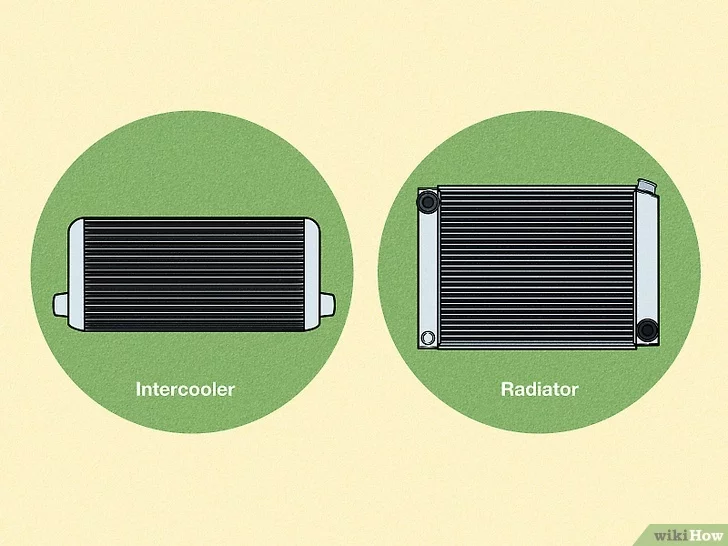
Image source: (Intercooler vs Radiator wikihow )
Why cooling fans and radiators are not aftercoolers
This is one of the most common misunderstandings in the field. A cooling fan helps move air, and a radiator helps dissipate heat from the engine or oil system. Neither guarantees that compressed air leaving the machine is cool enough for moisture separation.
In fact, many portable compressors rely on shared airflow paths: engine radiator, oil cooler, aftercooler.
When ambient temperature rises or the machine operates continuously at high load, the aftercooler often becomes the weakest link in this chain. The result is compressed air that meets pressure requirements but fails on air quality.
Air-cooled vs water-cooled aftercoolers
From a pure heat-transfer standpoint, water-cooled aftercoolers are more efficient. That’s basic thermodynamics, but real-world compressor operation is rarely ideal.
Air-cooled aftercoolers have simpler design, no dependency on cooling water, and easier to inspect and clean on site. Their limitation is ambient temperature. In hot or humid environments, their effectiveness drops noticeably.
Water-cooled aftercoolers have better temperature control, more stable outlet conditions, and higher moisture removal potential. Their downside is maintenance. Scaling, fouling, and poor water quality can quietly reduce performance long before users notice a problem.
This is why many mobile and rental air compressors still favor air-cooled aftercoolers, even when water cooling looks better on paper.
When the built-in aftercooler reaches its limit
On many jobsites, especially in drilling, mining, and pipeline work, operators start noticing symptoms like: Excessive water in air tools, frozen airlines in cold climates, corrosion inside hoses and fittings. The portable air compressor technically has an aftercooler — but it’s simply not enough for the operating conditions.
Common reasons include: Limited space for heat exchanger size in portable units, high ambient temperature reducing heat rejection, and continuous high-load operation with minimal cooling margin.
In these situations, a downstream external aftercooler can be a practical solution. Instead of modifying the compressor itself, an additional cooler installed after the outlet provides extra temperature drop and moisture separation — especially useful for mobile compressors running long duty cycles. This approach is often overlooked, yet widely used in demanding industrial applications.

Is an aftercooler high-maintenance?
Not really — but it is often under-maintained. Most aftercooler problems don’t cause sudden failure. They reduce performance gradually, typical reasons include: Dust buildup on air-cooled fins, oil mist coating heat exchanger surfaces, and internal scaling in water-cooled units.
Because the compressor still runs and delivers pressure, users tend to blame “bad air” on the machine itself rather than the cooling system. A simple inspection and cleaning routine usually restores most lost performance.
So, what should you look for when evaluating a “compressor cooler”?
Instead of focusing on labels, ask practical questions:
- What is the discharge air temperature at full load?
- How much moisture is actually removed before the outlet?
- Is the aftercooler sized for continuous operation in my climate?
- Can additional cooling be added if conditions change?
These questions matter far more than whether a brochure says “high-efficiency cooling system.”
Final thoughts
The term compressor cooler is vague — and that vagueness often leads to poor decisions. Once you separate engine cooling, airflow, intercooling, and aftercooling, the picture becomes much clearer.
For most users, the real issue is not whether a compressor has a cooler, but whether its aftercooling capacity matches the job. And when it doesn’t, understanding your options — from maintenance improvements to external aftercooling — can save significant downtime and downstream trouble.